
Roman Catholic
St Sigismund parish
05-507 Słomczyn
85 Wiślana Str.
Konstancin deanery
Warsaw archdiocese, Poland



full list:
displayClick to display full list

searchClick to search full list by categories
wyświetlKliknij by wyświetlić pełną listę po polsku

szukajKliknij by przeszukać listę wg kategorii po polsku

Martyrology of the clergy — Poland
XX century (1914 – 1989)
personal data


surname
KRÓL
forename(s)
Joseph (pl. Józef)


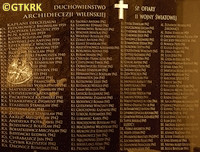
function
diocesan priest
creed
Latin (Roman Catholic) Church RCmore on
en.wikipedia.org
[access: 2014.09.21]
diocese / province
Vilnius archdiocesemore on
en.wikipedia.org
[access: 2013.05.19]
RC Military Ordinariate of Polandmore on
en.wikipedia.org
[access: 2014.12.20]
honorary titles
„Cross of Valour”more on
„Cross of Valour”
Shoulder cord (Norwegian) — national colours with a golden lion shieldmore on
Shoulder cord (Norwegian) – national colours with a golden lion shield
date and place
of death
17.04.1944

Newquay Baytoday: Cornwall Cou., England, United Kingdom
more on
en.wikipedia.org
[access: 2020.07.31]
details of death
On 01.01.1939 appointed reserve chaplain of the Polish Army (for a statutory 2‐year period).
On 24.08.1939, mobilized as chaplain of the 23rd Grodno Uhlan Regiment, part of the Vilnius Cavalry Brigade.
After the German and Russian invasion of the Poland in 09.1939, and the outbreak of World War II, took part in the defensive war of 09.1939. His Regiment fought near Piotrków Trybunalski, on the Przedbórz–Opoczno–Studzianna line, and when it began to retreat eastward, got surrounded on 09‐10.09.1939, near Przysucha. The commander issued orders to fight in small groups, attempting to move towards the Świętokrzyskie Mountains and Święta Katarzyna village. However, the Regiment was not reconstituted there.
It is known that in 09.1939 crossed the border into Romania and was interned there.
Escaped from the camp and made his way to France via Yugoslavia and Italy.
Reached the Polish Army, which was being formed in France, and became a chaplain at the Polish training camp in Coëtquidan (known by Polish soldiers as „Guenons”), near Guer in Brittany. The camp was established on 12.09.1939, during the defensive September Campaign in Poland, and from 21.10.1939, to 02.02.1940, its commandant was General Stanislav Maczek. C. 22,000 Polish soldiers were trained there, among others in the use of French weapons from World War I.
On 16.02.1940, became chaplain of the 1st Half–Brigade of the Independent Podhale Rifle Brigade.
On 22.04.1940, the Brigade set off for Norway. Till 06.1940, participated in the fighting near Narvik in Norway, a non‐frozen transshipment port for Swedish iron ore. Took part in the capture of Narvik on 28.05.1940 — the first victory of the Allied forces in World War II. The application for the Cross of Valor stated, among other things, „During several serious bombardments of the 1st Half–Brigade headquarters, demonstrated outstanding calmness, courage and composure, setting an edifying example for soldiers and officers”; and also: „There were times when, burdened with a backpack, would take a rifle or an ammunition box from one of the shooters to make their work easier, would always tell them something cheerful and interesting, take something to smoke, eat or drink from his backpack and offer it to everyone. In the hardest moments, was able to maintain a good mood and well‐being, always stood by the soldier's side”.
A few days later, however, Narvik had to be abandoned, and on 08.06.1940, returned to Brittany. The German invasion of France was already underway, beginning on 10.05.1940, with an attack on Belgium and the Netherlands. From 05.06.1940, the German offensive began, leading to the capture of Paris on 14.06.1940.
Still in 06.1940, evacuated to Great Britain. Settled with the Polish army in Scotland, i.a. in a camp in Douglas, c. 40 km south of Glasgow. There, from 07.1940, the 2nd Rifle Brigade of the Polish Armed Forces was being formed, and on 03.11.1940 transformed into the 10th Armoured Cavalry Brigade, which was to be part of the planned 1st Polish Corps. Became chaplain of the Podhale Riflemen Battalion, formed from soldiers evacuated from France.
After the German attack on 22.06.1941, on their erstwhile ally, the Russians, and after the Sikorski–Mayski Agreement of 30.07.1941, which restored diplomatic relations between Russia and Poland, participated in the creation of the Polish army in Russia, under the command of General Vladislav Anders, initially as chaplain of the Polish Military Mission and delegate of the Field Bishop.
From 12.12.1941, the chief chaplain of the 7th Infantry Division, which was being formed in Kermine (today Navoi) in Uzbekistan, c. 160 km northwest of Samarkand. Next, from 18.07.1942, deputy head of the Polish Army chaplaincy in Russia. The Russians hindered the formation of the army — sanitary and food conditions were appaling — and on 05‐09.08.1942, the Division was transported by rail to Krasnovodsk (today Turkmenbashi), and then on 12.08.1942, via the Caspian Sea — on the „Kaganovich” and „Zhdanov” ships — left the Russian „inhuman land” and was transported to Pahlevi (today Bandar‐e Anzali) in British–controlled Iran, and from there 16.08‐08.09.1942, to the camp in Chanakin, c. 160 km northeast of Baghdad, Iraq, just off the border with Iran.
On 26.09.1942, briefly appointed chaplain of the transit camp for Polish civilian refugees who had left Russia with the Polish Army, in Kermanshah, Iran.
Next, on 29.10.1942, appointed deputy chief chaplain of the 5th Vilnius Infantry Division, part of the Polish Army in the East‐the new name for the Polish forces in the Middle East‐and returned to Chanakin.
In 03.1943, as part of another reorganization, became chief chaplain of the newly established 5th Borderlands Infantry Division (the former 5th Vilnius Infantry Division was transformed into the 5th Vilnius Infantry Brigade and became part of the new division), and on 20.03.1943, promoted to senior chaplain.
In mid‐04.1943, the Division was transported to Kirkuk, in northern Iraq. There, protected the oil fields while conducting intensive training.
On 20.08.1943, appointed deputy head of the chaplaincy of the the 2nd Polish Corps, established on 21.07.1943 — i.a. from among the units of the Polish Army in the East .Immediately afterwards, at the turn of 08/09.1943, the 2nd Corps was regrouped to the British Mandate of Palestine (e.g. the 5th Borderlands Infantry Division in the Mughazi–Nuseirat region, c. 20 km south of Gaza).
In 11.1943, the Corps began its relocation to Egypt. On 12.12.1943, the Corps headquarters moved to the Qassasin camp, c.30 km from Ismailia in the Nile Delta, to begin its transfer the same month to Taranto, in the south of the Italian Peninsula, in Italy.
Then, on 14.01.1944, reported to VI Detachment (Special), a cell of the Commander‐in‐Chief's Staff in London — established on 29.06.1940, and cooperating closely with the Polish section of the British Special Operations Executive, i.e. SOE, which was responsible for all military communications with occupied Poland, including the airdrop of equipment and funds, as well as the recruitment, training, and airdrops of pl. „Cichociemni” (Eng. „Silent Unseen”) for the Polish resistance Home Army AK in occupied Poland. The unit was treated as a AK cell, and its officers and civilian employees took the AK oath. Began training the „Silent Unseen” —i.e.
the AK Silent Unseen Paratroopers, soldiers who volunteered for service in the occupied country — as its first chaplain.
Perished in a plane crash — either a mid‐air collision or explosion — while flying from the Royal Air Force RAF airfield in Lyneham, Wiltshire, to Gibraltar (from where was supposed to continue on to Bari, Italy, from where in turne planes carrying „Silent Unseen” airdrops to Poland were taking off).
cause of death
accident
sites and events
Ribbentrop‐MolotovClick to display the description, Pius XI's encyclicalsClick to display the description
date and place
of birth
21.03.1905Birth certification on:
metryki.genbaza.pl
[access: 2025.04.13]

Ignacówkatoday: Jędrzejów gm., Jędrzejów pov., Holy Cross voiv., Poland
more on
en.wikipedia.org
[access: 2022.01.06]
parents
KRÓL Andrew
🞲 ?, ? — 🕆 ?, ?

MARCINKOWSKA Rosalie
🞲 ?, ? — 🕆 ?, ?
baptism
22.03.1905Birth certification on:
metryki.genbaza.pl
[access: 2025.04.13]

Jędrzejówform.: Andrzejów
today: Jędrzejów gm., Jędrzejów pov., Holy Cross voiv., Poland
more on
en.wikipedia.org
[access: 2021.06.07]
Holy Trinity RC church
presbyter (holy orders)
ordination
04.06.1933

Vilniustoday: Vilnius city dist., Vilnius Cou., Lithuania
more on
en.wikipedia.org
[access: 2022.01.06]
St John the Baptist and St John the Evangelist RC churchmore on
en.wikipedia.org
[access: 2017.05.20]
positions held
from 14.01.1944
RC senior military chaplain — (England territory)today: England, United Kingdom ⋄ Branch VI (Special), Home Army AK, Polish Armed Forces — „Silent Unseen”, preparing for an airdrop into occupied Poland
20.08.1943 – 14.01.1944
RC senior military chaplain — 2nd Corps (Poland), Polish Armed Forces — deputy head of pastoral care
03.1943 – 20.08.1943
RC senior military chaplain — Kirkuktoday: Kirkuk prov., Iraq
more on
en.wikipedia.org
[access: 2025.08.19] ⋄ 5th Borderlands Division, Polish Army in the East (i.e. Anders Army), Polish Armed Forces — known as deputy military pastor
20.03.1943
RC senior military chaplain — Polish Armed Forces — appointed a senior military chaplain in major rank
29.10.1942 – 03.1943
RC military chaplain — Khanaqintoday: Khanaqin dist., Diyala prov., Iraq
more on
en.wikipedia.org
[access: 2023.08.19] ⋄ 5th Vilnius Infantry Division, Polish Army in the East (i.e. Anders Army), Polish Armed Forces — known as deputy military pastor
26.09.1942 – 10.1942
RC military chaplain — Kermanshahtoday: Kermanshah prov., Iran
more on
en.wikipedia.org
[access: 2025.08.19] ⋄ transit camp, Polish Armed Forces
18.07.1942 – 09.1942
RC military chaplain — (Russia territory)today: Russia
more on
en.wikipedia.org
[access: 2022.08.05] ⋄ Polish Armed Forces in Soviet Russia (i.e. Anders Army), Polish Armed Forces — deputy head of pastoral care
12.12.1941 – 18.07.1942
RC military chaplain — Kerminetoday: Navoiy, Karmana dist., Navoiy reg., Uzbekistan
more on
en.wikipedia.org
[access: 2023.08.19] ⋄ 7th Infantry Division, Polish Armed Forces in Soviet Russia (i.e. Anders Army), Polish Armed Forces
c. 08.1941 – 12.1941
RC military chaplain — (Russia territory)today: Russia
more on
en.wikipedia.org
[access: 2022.08.05] ⋄ Military Mission, Polish Armed Forces — also: delegate of the Military Bishop
07.1940 – c. 08.1941
RC military chaplain — (Scotland territory)today: Scotland, United Kingdom
more on
en.wikipedia.org
[access: 2020.07.31] ⋄ Podhale Rifle Battalion, 10th Armored Cavalry Brigade (till 03.11.1940 2nd Rifle Brigade), Polish Armed Forces
16.02.1940 – 06.1940
RC military chaplain — 1st Half‐Brigade, Independent Podhale Rifle Brigade, Polish Armed Forces
1939 – 02.1940
RC military chaplain — Guertoday: Vannes arr., Morbihan dep., Bretagne reg., France
more on
en.wikipedia.org
[access: 2025.08.19] ⋄ Coëtquidan Training Camp, Polish Armed Forces
24.08.1939 – 09.1939
RC military chaplain — 23rd Grodno Uhlan Regiment, Polish Armed Forces — mobilised, in the captain rank
13.01.1937 – 1939
parish priest — Yaznatoday: Yazna ssov., Myory dist., Vitebsk reg., Belarus
more on
be.wikipedia.org
[access: 2023.01.18] ⋄ Blessed Virgin Mary of Gate of Heaven RC parish ⋄ Hlybokayetoday: Hlybokaye dist., Vitebsk reg., Belarus
more on
en.wikipedia.org
[access: 2021.10.09] RC deanery
29.10.1935 – 1937
parish priest — Balingradastoday: Magūnai eld., Švenčionys dist., Vilnius Cou., Lithuania
more on
lt.wikipedia.org
[access: 2022.01.06] ⋄ Divine Providence RC parish ⋄ Verkiai Calvarytoday: part of Vilnius, Vilnius city dist., Vilnius Cou., Lithuania
more on
en.wikipedia.org
[access: 2020.11.27] RC deanery
1933 – 1935
vicar — Dąbrowa Grodzieńskatoday: Dąbrowa Białostocka, Dąbrowa Białostocka gm., Sokółka pov., Podlaskie voiv., Poland
more on
en.wikipedia.org
[access: 2021.09.29] ⋄ St Stanislav the Bishop and Martyr RC parish ⋄ Dąbrowa Grodzieńskatoday: Dąbrowa Białostocka, Dąbrowa Białostocka gm., Sokółka pov., Podlaskie voiv., Poland
more on
en.wikipedia.org
[access: 2021.09.29] RC deanery
from 07.06.1933
vicar — Lipnishkitoday: Lipnishki ssov., Ivye dist., Grodno reg., Belarus
more on
be.wikipedia.org
[access: 2023.01.18] ⋄ St Casimir the Prince and Confessor RC parish ⋄ Vishnyevatoday: Vishnyeva ssov., Valozhyn dist., Minsk reg., Belarus
more on
en.wikipedia.org
[access: 2021.09.29] RC deanery
till c. 1933
student — Vilniustoday: Vilnius city dist., Vilnius Cou., Lithuania
more on
en.wikipedia.org
[access: 2022.01.06] ⋄ philosophy and theology, Department of Theology, Stephen Batory University [i.e. Vilnius University (from 1945) / some faculties acting clandestinely (1939‐1945) / closed by Lithuanians (1939) / Stephen Batory University (1919‐1939)]
1927 – 1933
student — Vilniustoday: Vilnius city dist., Vilnius Cou., Lithuania
more on
en.wikipedia.org
[access: 2022.01.06] ⋄ philosophy and theology, Theological Seminary
others related
in death
SAMULSKIClick to display biography Thomas, BIKClick to display biography Emanuel (Fr Charles), BORYŃSKIClick to display biography Henry, HUPAClick to display biography Victor (Fr Fortunate), MISIUDAClick to display biography Hubert Victor, POGŁÓDEKClick to display biography Constantine, TARGOSZClick to display biography Stanislav Peter
sites and events
descriptions
Ribbentrop‐Molotov: Genocidal Russian‐German alliance pact between Russian leader Joseph Stalin and German leader Adolf Hitler signed on 23.08.1939 in Moscow by respective foreign ministers, Mr. Vyacheslav Molotov for Russia and Joachim von Ribbentrop for Germany. The pact sanctioned and was the direct cause of joint Russian and German invasion of Poland and the outbreak of the World War II in 09.1939. In a political sense, the pact was an attempt to restore the status quo ante before 1914, with one exception, namely the „commercial” exchange of the so‐called „Kingdom of Poland”, which in 1914 was part of the Russian Empire, fore Eastern Galicia (today's western Ukraine), in 1914 belonging to the Austro‐Hungarian Empire. Galicia, including Lviv, was to be taken over by the Russians, the „Kingdom of Poland” — under the name of the General Governorate — Germany. The resultant „war was one of the greatest calamities and dramas of humanity in history, for two atheistic and anti‐Christian ideologies — national and international socialism — rejected God and His fifth Decalogue commandment: Thou shall not kill!” (Abp Stanislav Gądecki, 01.09.2019). The decisions taken — backed up by the betrayal of the formal allies of Poland, France and Germany, which on 12.09.1939, at a joint conference in Abbeville, decided not to provide aid to attacked Poland and not to take military action against Germany (a clear breach of treaty obligations with Poland) — were on 28.09.1939 slightly altered and made more precise when a treaty on „German‐Russian boundaries and friendship” was agreed by the same murderous signatories. One of its findings was establishment of spheres of influence in Central and Eastern Europe and in consequence IV partition of Poland. In one of its secret annexes agreed, that: „the Signatories will not tolerate on its respective territories any Polish propaganda that affects the territory of the other Side. On their respective territories they will suppress all such propaganda and inform each other of the measures taken to accomplish it”. The agreements resulted in a series of meeting between two genocidal organization representing both sides — German Gestapo and Russian NKVD when coordination of efforts to exterminate Polish intelligentsia and Polish leading classes (in Germany called «Intelligenzaktion», in Russia took the form of Katyń massacres) where discussed. Resulted in deaths of hundreds of thousands of Polish intelligentsia, including thousands of priests presented here, and tens of millions of ordinary people,. The results of this Russian‐German pact lasted till 1989 and are still in evidence even today. (more on: en.wikipedia.orgClick to attempt to display webpage
[access: 2015.09.30])
Pius XI's encyclicals: Facing the creation of two totalitarian systems in Europe, which seemed to compete with each other, though there were more similarities than contradictions between them, Pope Pius XI issued in 03.1937 (within 5 days) two encyclicals. In the „Mit brennender Sorge” (Eng. „With Burning Concern”) published on 14.03.1938, condemned the national socialism prevailing in Germany. The Pope wrote: „Whoever, following the old Germanic‐pre‐Christian beliefs, puts various impersonal fate in the place of a personal God, denies the wisdom of God and Providence […], whoever exalts earthly values: race or nation, or state, or state system, representatives of state power or other fundamental values of human society, […] and makes them the highest standard of all values, including religious ones, and idolizes them, this one […] is far from true faith in God and from a worldview corresponding to such faith”. On 19.03.1937, published „Divini Redemptoris” (Eng. „Divine Redeemer”), in which criticized Russian communism, dialectical materialism and the class struggle theory. The Pope wrote: „Communism deprives man of freedom, and therefore the spiritual basis of all life norms. It deprives the human person of all his dignity and any moral support with which he could resist the onslaught of blind passions […] This is the new gospel that Bolshevik and godless communism preaches as a message of salvation and redemption of humanity”… Pius XI demanded that the established human law be subjected to the natural law of God , recommended the implementation of the ideal of a Christian state and society, and called on Catholics to resist. Two years later, National Socialist Germany and Communist Russia came together and started World War II. (more on: www.vatican.vaClick to attempt to display webpage
[access: 2023.05.28], www.vatican.vaClick to attempt to display webpage
[access: 2023.05.28])
sources
personal:
www.archibial.plClick to attempt to display webpage
[access: 2015.05.09], www.niedziela.plClick to attempt to display webpage
[access: 2015.05.09], metryki.genbaza.plClick to attempt to display webpage
[access: 2025.04.13], ordynariat.wp.mil.plClick to attempt to display webpage
[access: 2025.08.19]
bibliographical:
„Martyrology of the Polish Roman Catholic clergy under nazi occupation in 1939‐1945”, Victor Jacewicz, John Woś, vol. I‐V, Warsaw Theological Academy, 1977‐1981
„Vilnius archdiocese clergy martyrology 1939‐1945”, Fr Thaddeus Krahel, Białystok, 2017
original images:
www.bialystok.opoka.org.plClick to attempt to display webpage
[access: 2013.01.06], jml2012.indexcopernicus.comClick to attempt to display webpage
[access: 2017.05.20], www.polishwargraves.nlClick to attempt to display webpage
[access: 2015.05.09], www.katedrapolowa.plClick to attempt to display webpage
[access: 2014.01.16], ipn.gov.plClick to attempt to display webpage
[access: 2019.02.02], www.ciekawepodlasie.plClick to attempt to display webpage
[access: 2020.07.31]
LETTER to CUSTODIAN/ADMINISTRATOR
If you have an Email client on your communicator/computer — such as Mozilla Thunderbird, Windows Mail or Microsoft Outlook, described at WikipediaPatrz:
en.wikipedia.org, among others — try the link below, please:
LETTER to CUSTODIAN/ADMINISTRATORClick and try to call your own Email client
If however you do not run such a client or the above link is not active please send an email to the Custodian/Administrator using your account — in your customary email/correspondence engine — at the following address:

giving the following as the subject:
MARTYROLOGY: KRÓL Joseph
To return to the biography press below:
 Click to return to biography