
Roman Catholic
St Sigismund parish
05-507 Słomczyn
85 Wiślana Str.
Konstancin deanery
Warsaw archdiocese, Poland




full list:
displayClick to display full list

searchClick to search full list by categories
wyświetlKliknij by wyświetlić pełną listę po polsku

szukajKliknij by przeszukać listę wg kategorii po polsku

Martyrology of the clergy — Poland
XX century (1914 – 1989)
personal data
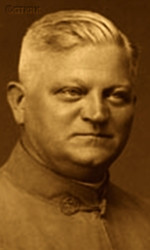
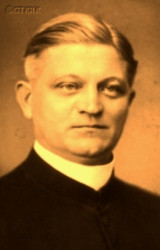
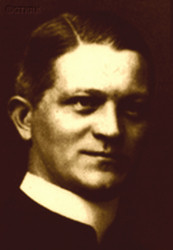
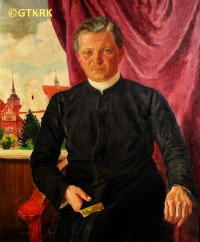
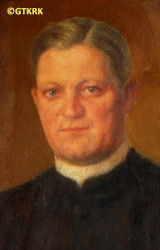
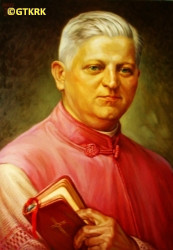
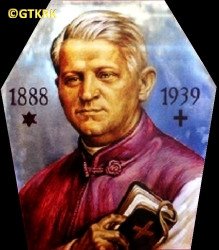
religious status
Servant of God
surname
ROSZCZYNIALSKI
forename(s)
Edmund
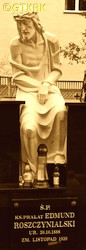

function
diocesan priest
creed
Latin (Roman Catholic) Church RCmore on
en.wikipedia.org
[access: 2014.09.21]
diocese / province
Culm (Chełmno) diocesemore on
pl.wikipedia.org
[access: 2012.11.23]
RC Military Ordinariate of Polandmore on
en.wikipedia.org
[access: 2014.12.20]
honorary titles
Papal chamberlainmore on
en.wikipedia.org
[access: 2014.11.22]
(1933)
„Polonia Restituta” Cross — 5th Class, Knight'smore on
en.wikipedia.org
[access: 2019.04.16]
(08.11.1930)
Gold „Cross of Merit”more on
en.wikipedia.org
[access: 2019.04.16]
(11.11.1937)
date and place
of death
10.11.1939

Cewicetoday: Cewice gm., Lębork pov., Pomerania voiv., Poland
more on
en.wikipedia.org
[access: 2022.01.28]
alt. dates and places
of death
11.11.1939, 12.11.1939
details of death
In the years 1904‐1907 — during German occupation (Prussian part of partitioned Poland) — while studying at the Germ. Königliches Gymnasium (Eng. Royal Gymnasium) in Wejherowo, member of the school chapter of the Polish clandestine student self–education Pomeranian Philomaths organization.
During World War I drafted in 02.1917 into German Imperial Army. In 1917‐1918 ministered as a chaplain and nurse.
After German and Russian invasion of Poland in 09.1939 and start of the World War II, after start of German occupation, founder of the clandestine charity organisation pl. „Pomoc Polakom” (Eng. „Help to the Poles”) — later transformed into pl. „Polska Żyje” (Eng. „Poland Lives”), which in turn in 1942 joined the Secret Military Organization pl. „Gryf Pomorski” (Eng. „Pomeranian Griffin”, operating in Pomerania — also known as „Charitas”, providing help to war victims, widows and children of Poles murdered by the Germans.
Arrested by the Germans on 30.10.1939, c. 10 days after the Germans began a wave of arrests of Poles in Gdynia and other towns in Polish coastal counties. The arrests included almost all Polish Catholic priests from this region, including his parish town of Wejherowo. The arrests were carried out by virtually all armed German units operating in this occupied region. Since power had already been transferred from the Germ. Wehrmacht (Eng. Armed Forces) to civilians, these were units of the paramilitary Germ. Die Schutzstaffel der NSDAP (Eng. NSDAP protection unit), i.e. «SS», subordinate to the ruling National Socialist German Workers' Party NSDAP; agents of the Germ. Geheime Staatspolizei (Eng. Secret State Police), i.e. Gestapo; agents of the intelligence, counterintelligence, and security service of the Germ. Sicherheitsdienst des Reichsführers SS (Security Service of the Reichsführer SS), i.e. «SD»; as well as agents of the genocidal paramilitary formation of the Germ. Volksdeutscher Selbstschutz (Eng. Self‐Defense of Ethnic Germans), i.e. VS, whose members were Germ. Volksdeutsche (Eng. Ethnic Germans) — i.e. treacherous representatives of the German minority in Poland.
The arrest campaign in Pomerania — which marked the beginning of eventual genocide — was initiated by the Germ. Gaulaiter of the NSDAP (Eng. NSDAP district head) of the Free City of Danzig, i.e. WMG, who on 26.10.1939, on the day the Germ. Reichsgau Danzig Westpreussen (Eng. Reich District Gdańsk‐West Prussia) was established, became its Germ. Reichsstatthalter (Eng. Reich Chief). This German gentleman was said to have said in a speech shouted from the appropriated Prusiński Hotel in Wejherowo at the beginning of 10.1939: „We must exterminate these lousy Poles, starting from the cradle […] I place the fate of the Poles in your hands, you can do with them whatever you want!” The reaction of the gathered German mob was said to have been shouts of „May the Polish dogs perish!” and „Death to the Poles!”.
Most of the arrested individuals were on one of the so‐called Germ. Sonderfahndungsliste (Eng. Special Wanted List), prepared before the German aggression. This was a proscription list of names of „enemies of the Reich” who fell victim to the genocidal plan known as Germ. «Intelligenzaktion» (pl. „Intelligentsia Action”), the extermination of the intelligentsia and the Germ. „Führungsschicht” (Eng. „Leadership Class”) of Poland.
Locked in a prison in Wejherowo, where the Germans had gathered several thousand people, brought from various locations in Pomerania. Prisoners, held in overcrowded cells, were — including Catholic clergy — tortured during interrogations.
On 10.11.1939, the day before Poland's national Independence Day, deported from Wejherowo and transported c. 35 km west to the prison in Lębork. This way avoided the murder of dozens of Catholic priests held in the prison in Wejherowo, who on 11.11.1939 were genocidally killed — in the Piaśnica forests, c. 1 km from the center of the village of Wielka Piaśnica, near Wejherowo in Pomerania, in a place today referred to as the „Pomeranian Katyn” or the „Kashubian Golgotha”.
It seems that the deportation was not accidental. Prob. was the result of the issuance by German Major General (later Field Marshal) Erwin Johannes Eugen Rommel, who was then the commandant of the Germ. Führerbegleitbatallion (Eng. Führer's Escort Battalion) and protected the Führer, i.e. Reich Chancellor Adolf Hitler, during the German invasion of Poland in the mobile Germ. Führerhauptquartier (Eng. Führer's Headquarters), of a „safe conduct” — a guarantee — intended to protect against arrest by German police authorities. Rommel, whose wife was a cousin of Fr Roszczynialski, prob. issued this safe conduct during his stay with Hitler at the Kasino‐Hotel in Sopot on 19‐26.09.1939. The authors of „Liber Albus” do not know the content of the guarantee, but it is possible that it was territorially limited and that is why Fr Roszczynialski was exceptionally taken to Lębork, which was located in the Germ. Provinz Pommern (Eng. Pomeranian Province), which before the German aggression against Poland belonged to Germany. The Germans — unrivaled formalists — initially murdered only in territories considered occupied and initially avoided killing Poles even on the WMG territory, despite the announcement as early as on 01.09.1939 of the Germ. Anschluss (Eng. annexation) of WMG to the Third Reich, and chose locations in Poland as the places of murder, e.g. Piaśnica: for example, in the KL Stutthof concentration camp, located within the territory of the WMG, the first Catholic priests and residents of Gdańsk were murdered only in 01.1940.
The next day moved — sources indicate that it was probably by «SS» agents: in Lębork there was i.a. a school for «SS» officers — eastward, to Cewice, c. 11 km away.
There, on the outskirts of the village, in a park behind the school / in the sloped woods, forced to dig a hole and murdered.
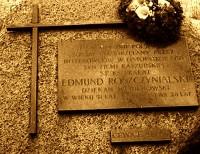
For years, it was believed that had been murdered in Piaśnica. Until 1979, when playing children discovered his remains. The exhumation took place on 03.09.1979. On 25.09.1979, his remains were placed in a family grave in the cemetery in Wejherowo.
cause of death
murder
perpetrators
Germans
sites and events
LęborkClick to display the description, PiaśnicaClick to display the description, KL StutthofClick to display the description, WejherowoClick to display the description, «Intelligenzaktion»Click to display the description, Reichsgau Danzig‐WestpreußenClick to display the description, Ribbentrop‐MolotovClick to display the description, Pius XI's encyclicalsClick to display the description, Pomeranian PhilomathsClick to display the description
date and place
of birth
30.10.1888

Łężycetoday: Wejherowo gm., Wejherowo pov., Pomerania voiv., Poland
more on
en.wikipedia.org
[access: 2022.01.28]
parents
ROSZCZYNIALSKI Marian Adam Valentine
🞲 12.02.1859, Pruszczalso: Pruszcz Pomorski
today: Pruszcz gm., Świecie pov., Kuyavia‐Pomerania voiv., Poland
more on
en.wikipedia.org
[access: 2021.12.18] — 🕆 04.02.1937, ?

MALOTKA Euphrosyne Pauline Joanna
🞲 30.07.1865, Łężycetoday: Wejherowo gm., Wejherowo pov., Pomerania voiv., Poland
more on
en.wikipedia.org
[access: 2022.01.28] — 🕆 15.09.1928, ?
presbyter (holy orders)
ordination
09.03.1913

Pelplintoday: Pelplin gm., Tczew pov., Pomerania voiv., Poland
more on
en.wikipedia.org
[access: 2021.05.06]
St Barbara RC chapelmore on
pl.wikipedia.org
[access: 2021.12.19] (in Theological Seminary)
positions held
1926 – 1939
dean — Wejherowotoday: Wejherowo gm., Wejherowo pov., Pomerania voiv., Poland
more on
en.wikipedia.org
[access: 2021.09.02] RC deanery
1924 – 1939
parish priest — Wejherowotoday: Wejherowo gm., Wejherowo pov., Pomerania voiv., Poland
more on
en.wikipedia.org
[access: 2021.09.02] ⋄ Holy Trinity RC parish ⋄ Wejherowotoday: Wejherowo gm., Wejherowo pov., Pomerania voiv., Poland
more on
en.wikipedia.org
[access: 2021.09.02] RC deanery — also: co‐founder–shareholder of „Kashubian Newspaper” (1922) and member of its Supervisory Board
1936
sea chaplain — „MS Pilsudski” ocean liner, passenger ships of the Polish Transatlantic Ship Society
1920 – 1926
prefect — Wejherowotoday: Wejherowo gm., Wejherowo pov., Pomerania voiv., Poland
more on
en.wikipedia.org
[access: 2021.09.02] ⋄ Teachers' Seminary [i.e. State Pedagogical High School (1935‐1939) / State Teachers' Seminary (till 1935)] ⋄ Holy Trinity RC parish — director (1924‐1926)
1918 – 1920
vicar — Grudziądztoday: Grudziądz city pov., Kuyavia‐Pomerania voiv., Poland
more on
en.wikipedia.org
[access: 2021.09.02] ⋄ RC parish ⋄ Grudziądztoday: Grudziądz city pov., Kuyavia‐Pomerania voiv., Poland
more on
en.wikipedia.org
[access: 2021.09.02] RC deanery
1917 – 1918
RC military chaplain — German Imperial Army
1913 – 1917
vicar — Drzycimtoday: Drzycim gm., Świecie pov., Kuyavia‐Pomerania voiv., Poland
more on
en.wikipedia.org
[access: 2021.09.02] ⋄ Purification of the Blessed Virgin Mary and All the Saints RC parish ⋄ Świecietoday: Świecie gm., Świecie pov., Kuyavia‐Pomerania voiv., Poland
more on
en.wikipedia.org
[access: 2021.09.02] RC deanery
1907 – 1913
student — Pelplintoday: Pelplin gm., Tczew pov., Pomerania voiv., Poland
more on
en.wikipedia.org
[access: 2021.05.06] ⋄ philosophy and theology, Theological Seminary — with a break in 1909‐1910
from 1904
pupil — Wejherowotoday: Wejherowo gm., Wejherowo pov., Pomerania voiv., Poland
more on
en.wikipedia.org
[access: 2021.09.02] ⋄ Germ. Königliche Gymnasium (Eng. Royal Gymnasium) — studies crowned in 1907 with the maturity diploma (i.e. matura)
pupil — Chojnicetoday: Chojnice urban gm., Chojnice pov., Pomerania voiv., Poland
more on
en.wikipedia.org
[access: 2021.09.02] ⋄ Germ. Königliche Katholische Gymnasium (Eng. Royal Catholic Gymnasium)
1915 – 1939
membership — Toruńtoday: Toruń city pov., Kuyavia‐Pomerania voiv., Poland
more on
en.wikipedia.org
[access: 2021.06.20] ⋄ scientific society
activist — social
publisher, publicist
others related
in death
PLEWAClick to display biography Theodore
sites and events
descriptions
Lębork: German detention centre — regarded as Gefängnis (Eng. jail) — prob. operational in 1939‐1945.
Piaśnica: In the forests of Piaśnica, c. 1 km from the center of Wielka Piaśnica village near Wejherowo in Pomerania, as part of the Germ. «Intelligenzaktion», from 10.1939 to 04.1940, the Germans murdered, in mass executions, 12,000‐14,000 Poles from Gdańsk Pomerania, mostly Polish intelligentsia. Genocides were committed by SS units (including the Wachsturmbann „Eimann” unit) with the help of members of the paramilitary organization Volksdeutscher Selbstschutz, consisting of treacherous Polish citizens of German origin. Arrested people who found themselves on the one of the so‐called Germ. Sonderfahndungsliste (Eng. Special Wanted List), i.e. a proscription list of names of „enemies of the Reich”, prepared before the German aggression, or on some other proscription list, drawn up ad hoc by the local Germ. Volksdeutsche (Eng. Ethnic Germans), i.e. representatives of the German minority in Poland. The victims were usually transported by trains to Wejherowo, in closed wagons attached to a regular passenger services. There, the wagons were detached and the victims, after a brutal selection, with families and children separated, were loaded onto trucks and buses. There pits were awaiting them, dug out initially by local German farmers, and later by Polish‐prisoners from the Germ. Neufahrwasser camp in Gdańsk, known as the Germ. „Himmelfahrtskommando” (Eng. „Ascension into Heaven commando”) — these after some time were murdered and new ones were brought in. The victims had to undress to their underwear, and then in groups of 5‐6 people were murdered with a shot to the back of the head, standing or kneeling over a dug hole. The wounded were finished off — some with rifle butts. Some of the children were murdered by smashing their heads against tree trunks. The graves were then covered, and in 1940 seedlings of trees and bushes were planted on them. In 1944, facing the approaching German–Russian front and inevitable defeat, as part of the Germ. „Sonderaktion 1005” (Eng. „Special Action 1005”), groups of prisoners from the KL Stutthof concentration camp, referred to as Germ. „Leichenkommandos” (Eng. „Corpses' Units”) — under the supervision of Germans, members of the genocidal Germ. Sicherheitsdienst des Reichsführers SS (Eng. Security Service of the Reichsführer SS), i.e. «SD» — dug up the bodies of the murdered and burned them. The Germans then murdered the prisoners. Piaśnica is referred to as „Pomeranian Katyn” or „Kashubian Golgota”. (more on: en.wikipedia.orgClick to attempt to display webpage
[access: 2021.10.09])
KL Stutthof: In German Germ. Konzentrationslager (Eng. concentration camp) KL Stutthof (then in Eastern Prussian belonging to Germany, today: Sztutowo village) concentration camp, that Germans started to build on 02.09.1939, a day after German invasion of Poland and start of the World War II, Germans held c. 110,000‐127,000 prisoners from 28 countries, including 49,000 women and children. C. 65,000 victims were murdered and exterminated. In the period of 25.01‐27.04.1945 in the face of approaching Russian army Germans evacuated the camp. When on 09.05.1945 Russians soldiers entered the camp only 100 prisoners were still there. In an initial period (1939‐1940) Polish Catholic priests from Pomerania were held captive there before being transported to KL Dachau concentration camp. Some of them were murdered in KL Stutthof or vicinity (for instance in Stegna forest). Also later some Catholic priests were held in KL Stutthof. (more on: stutthof.orgClick to attempt to display webpage
[access: 2018.11.18], en.wikipedia.orgClick to attempt to display webpage
[access: 2013.07.06])
Wejherowo: A detention center built in c. 1877, taken over by the Germans after the German invasion of Poland on 01.09.1939. The first murders were committed there on 10.09.1939. In the detention center, designed for c. 300 people, the Germans held up to around 3,000 people — they were even held in the chapel and corridors. Among the detainees were Polish prisoners of war. In 1939, as part of the «Intelligenzaktion» — an action to exterminate Polish intelligentsia and leadership classes — the final selection of Poles brought by train was also carried out there, before being sent to the place of genocidal murders in Piaśnica. C. 2,000 prisoners from the detention center itself, detained in Wejherowo and nearby villages, were also taken there and murdered. (more on: www.sw.gov.plClick to attempt to display webpage
[access: 2013.08.17])
«Intelligenzaktion»: German: «Intelligenzaktion» (English: „Intelligence Action”) — a German program of extermination of the Polish elite, mainly the intelligentsia and leadership layers, carried out from the beginning of the occupation in w 09.1939 to 04.1940, mainly in territories directly annexed to Germany, but also in the so‐called Germ. Generalgouvernement (Eng. General Governorate), where it was called «AB‐aktion». In the first phase, immediately after the beginning of the German occupation, during military operations carried out by the Germ. Wehrmacht (Eng. Armed Forces) and the genocidal units of the Germ. Einsatzgruppen (Eng. Operational Groups) of the Germ. Sicherheitspolizei (Eng. Security Police), i.e. SiPo, and Germ. Sicherheitsdienst des Reichsführers SS (Eng. Security Service of the Reichsführer SS), i.e. SD, organized by the Germ. Reichssicherheitshauptamt (Eng. Reich Main Security Office), i.e. RSHA, which followed the troops, carried out under the Germ. Unternehmen „Tannenberg” (Eng. Operation „Tannenberg”) — based on the so‐called Germ. Sonderfahndungsliste (Eng. Special Wanted Lists), i.e. proscription lists of Poles considered particularly dangerous to the Third Reich, prepared by the Zentralstelle II/P (Polen) unit of the German RSHA. Later, implemented by the German civilian occupation authorities and the genocidal unit of the Germ. Volksdeutscher Selbstschutz (Eng. Ethnic Germans Self‐Defense), whose members were Germ. Volksdeutsche (Eng. Ethnic Germans), i.e. representatives of the German minority in Poland. According to various sources, these lists, at the beginning of 09.1939, could have contained the details of 61,000—88,000 „dangerous” Poles — although these figures cannot be confirmed. In total, during this genocide, c. 50,000 teachers, Catholic priests, representatives of the landed gentry, freelancers, social and political activists, and retired military personnel were systematically and methodically murdered. Another 50,000 were sent to concentration camps, where only a negligible percentage survived. (more on: en.wikipedia.orgClick to attempt to display webpage
[access: 2014.10.04])
Reichsgau Danzig‐Westpreußen: After the Polish defeat in the 09.1939 campaign, which was the result of the Ribbentrop‐Molotov Pact and constituted the first stage of World War II, and the beginning of German occupation in part of Poland (in the other, eastern part of Poland, the Russian occupation began), the Germans divided the occupied Polish territory into five main regions (and a few smaller). The largest one was transformed into Germ. Generalgouvernement (Eng. General Governorate), intended exclusively for Poles and Jews and constituting part of the so‐called Germ. Großdeutschland (Eng. Greater Germany). Two were added to existing German provinces. From two other separate new provinces were created. Vistula Pomerania region was one of them, incorporated into Germany on 08.10.1939, by decree of the German leader Adolf Hitler (formally came into force on 26.10.1939), and on 02.11.1939 transformed into the Germ. Reichsgau Danzig‐Westpreußen (Eng. Reich District of Gdańsk‐West Prussia) province, in which the law of the German state was to apply. The main axis of the policy of the new province, the territory of which the Germans recognized as the Germ. „Ursprünglich Deutsche” (Eng. „natively German”), despite the fact that 85% of its inhabitants were Poles, was Germ. „Entpolonisierung” (Eng. „Depolonisation”), i.e. forced Germanization. C. 60,000 Poles were murdered in 1939‐1940, as part of the Germ. „Intelligenzaktion”, i.e. extermination of Polish intelligentsia and ruling classes, in c. 432 places of mass executions — including c. 220 Polish Catholic priests. The same number were sent to German concentration camps, from where few returned (over 300 priests were arrested, of whom c. 130 died in concentration camps). C. 124,000‐170,000 were displaced, including c. 90,000 to the Germ. Generalgouvernement. Poles were forced en masse to sign the German nationality list, the Germ. Deutsche Volksliste DVL. Polish children could only learn in German. It was forbidden to use the Polish language during Catholic Holy Masses and during confession. Polish landed estates were confiscated..To further reduce the number of the Polish population, Poles were sent to forced labor deep inside Germany. The remaining Poles were treated as low‐skilled labor, isolated from the Germans and strictly controlled — legally, three or three of them could only meet together, even in their own apartments. Many were conscripted into the German Wehrmacht army. After the end of hostilities of World War II, the overseer of this province, the Germ. Reichsstatthalter (Eng. Reich Governor) and the Germ. Gauleiter (Eng. district head) of the German National Socialist Party, Albert Maria Forster, was executed. (more on: en.wikipedia.orgClick to attempt to display webpage
[access: 2024.06.24])
Ribbentrop‐Molotov: Genocidal Russian‐German alliance pact between Russian leader Joseph Stalin and German leader Adolf Hitler signed on 23.08.1939 in Moscow by respective foreign ministers, Mr. Vyacheslav Molotov for Russia and Joachim von Ribbentrop for Germany. The pact sanctioned and was the direct cause of joint Russian and German invasion of Poland and the outbreak of the World War II in 09.1939. In a political sense, the pact was an attempt to restore the status quo ante before 1914, with one exception, namely the „commercial” exchange of the so‐called „Kingdom of Poland”, which in 1914 was part of the Russian Empire, fore Eastern Galicia (today's western Ukraine), in 1914 belonging to the Austro‐Hungarian Empire. Galicia, including Lviv, was to be taken over by the Russians, the „Kingdom of Poland” — under the name of the General Governorate — Germany. The resultant „war was one of the greatest calamities and dramas of humanity in history, for two atheistic and anti‐Christian ideologies — national and international socialism — rejected God and His fifth Decalogue commandment: Thou shall not kill!” (Abp Stanislav Gądecki, 01.09.2019). The decisions taken — backed up by the betrayal of the formal allies of Poland, France and Germany, which on 12.09.1939, at a joint conference in Abbeville, decided not to provide aid to attacked Poland and not to take military action against Germany (a clear breach of treaty obligations with Poland) — were on 28.09.1939 slightly altered and made more precise when a treaty on „German‐Russian boundaries and friendship” was agreed by the same murderous signatories. One of its findings was establishment of spheres of influence in Central and Eastern Europe and in consequence IV partition of Poland. In one of its secret annexes agreed, that: „the Signatories will not tolerate on its respective territories any Polish propaganda that affects the territory of the other Side. On their respective territories they will suppress all such propaganda and inform each other of the measures taken to accomplish it”. The agreements resulted in a series of meeting between two genocidal organization representing both sides — German Gestapo and Russian NKVD when coordination of efforts to exterminate Polish intelligentsia and Polish leading classes (in Germany called «Intelligenzaktion», in Russia took the form of Katyń massacres) where discussed. Resulted in deaths of hundreds of thousands of Polish intelligentsia, including thousands of priests presented here, and tens of millions of ordinary people,. The results of this Russian‐German pact lasted till 1989 and are still in evidence even today. (more on: en.wikipedia.orgClick to attempt to display webpage
[access: 2015.09.30])
Pius XI's encyclicals: Facing the creation of two totalitarian systems in Europe, which seemed to compete with each other, though there were more similarities than contradictions between them, Pope Pius XI issued in 03.1937 (within 5 days) two encyclicals. In the „Mit brennender Sorge” (Eng. „With Burning Concern”) published on 14.03.1938, condemned the national socialism prevailing in Germany. The Pope wrote: „Whoever, following the old Germanic‐pre‐Christian beliefs, puts various impersonal fate in the place of a personal God, denies the wisdom of God and Providence […], whoever exalts earthly values: race or nation, or state, or state system, representatives of state power or other fundamental values of human society, […] and makes them the highest standard of all values, including religious ones, and idolizes them, this one […] is far from true faith in God and from a worldview corresponding to such faith”. On 19.03.1937, published „Divini Redemptoris” (Eng. „Divine Redeemer”), in which criticized Russian communism, dialectical materialism and the class struggle theory. The Pope wrote: „Communism deprives man of freedom, and therefore the spiritual basis of all life norms. It deprives the human person of all his dignity and any moral support with which he could resist the onslaught of blind passions […] This is the new gospel that Bolshevik and godless communism preaches as a message of salvation and redemption of humanity”… Pius XI demanded that the established human law be subjected to the natural law of God , recommended the implementation of the ideal of a Christian state and society, and called on Catholics to resist. Two years later, National Socialist Germany and Communist Russia came together and started World War II. (more on: www.vatican.vaClick to attempt to display webpage
[access: 2023.05.28], www.vatican.vaClick to attempt to display webpage
[access: 2023.05.28])
Pomeranian Philomaths: Secret societies of Polish youth, aiming at self‐education, patriotic in form and content, functioning 1830‐1920, mainly in secondary schools — gymnasia — in Pomerania around Vistula river (Gdańsk Pomerania and Chełmno county), in Prussian‐occupied Polish territories (one of the partitions of Poland). On 08.01.1901 Germans conducted a series of interrogations of students at Chełmno, Brodnica and Toruń gymnasiums. On 09‐12.09.1901 the first of court trials of Polish students from those gymnasiums and students of Theological Seminary in Pelplin was held in Toruń. 1 person was sentenced to 3 months in prison, 1 to 2 months, 3 to 6 weeks, 7 to 3 weeks, 2 to 2 weeks, 19 to a week, 2 to 1 day, 10 were reprimanded. 15 were cleared. More definitive penalties were relegations from the schools with so‐called wolf’s ticket, forbidding sentenced students to continue secondary and higher studies in Prussia (Germany). Among those penalized were a few future Catholic priests — those were able to continue their education for the Chełmno diocese bishop, Bp August Rosentreter, refused to relegate students from Theological Seminary. (more on: pl.wikipedia.orgClick to attempt to display webpage
[access: 2018.11.18])
sources
personal:
pl.wikipedia.orgClick to attempt to display webpage
[access: 2012.11.23], www.kaszubi.plClick to attempt to display webpage
[access: 2012.12.28], www.geni.comClick to attempt to display webpage
[access: 2025.11.10], www.hagiographycircle.comClick to attempt to display webpage
[access: 2012.11.23], biblioteka.wejherowo.plClick to attempt to display webpage
[access: 2013.05.19]
bibliographical:
„Biographical dictionary of priests of the Chełmno diocese ordained in the years 1821‐1920”, Henry Mross, Pelplin, 1995
original images:
pl.wikipedia.orgClick to attempt to display webpage
[access: 2012.11.23], www.zscewice.plClick to attempt to display webpage
[access: 2014.12.20], swtrojcawejherowo.comClick to attempt to display webpage
[access: 2015.09.30], swtrojcawejherowo.wordpress.comClick to attempt to display webpage
[access: 2018.11.18], swtrojcawejherowo.wordpress.comClick to attempt to display webpage
[access: 2014.12.20], www.myheritage.plClick to attempt to display webpage
[access: 2018.11.18], lubimyczytac.plClick to attempt to display webpage
[access: 2018.11.18], opencaching.plClick to attempt to display webpage
[access: 2014.12.20], mogily.plClick to attempt to display webpage
[access: 2018.11.18]
.jpg)
LETTER to CUSTODIAN/ADMINISTRATOR
If you have an Email client on your communicator/computer — such as Mozilla Thunderbird, Windows Mail or Microsoft Outlook, described at WikipediaPatrz:
en.wikipedia.org, among others — try the link below, please:
LETTER to CUSTODIAN/ADMINISTRATORClick and try to call your own Email client
If however you do not run such a client or the above link is not active please send an email to the Custodian/Administrator using your account — in your customary email/correspondence engine — at the following address:

giving the following as the subject:
MARTYROLOGY: ROSZCZYNIALSKI Edmund
To return to the biography press below:
 Click to return to biography