
Roman Catholic
St Sigismund parish
05-507 Słomczyn
85 Wiślana Str.
Konstancin deanery
Warsaw archdiocese, Poland


full list:
displayClick to display full list

searchClick to search full list by categories
wyświetlKliknij by wyświetlić pełną listę po polsku

szukajKliknij by przeszukać listę wg kategorii po polsku

Martyrology of the clergy — Poland
XX century (1914 – 1989)
personal data


surname
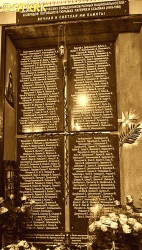
WASILEWSKI
forename(s)
Anthony Raymond (pl. Antoni Rajmund)
function
diocesan priest
creed
Latin (Roman Catholic) Church RCmore on
en.wikipedia.org
[access: 2014.09.21]
diocese / province
Mogilev archdiocesemore on
en.wikipedia.org
[access: 2013.06.23]
academic distinctions
Sacred Theology Candidate
honorary titles
honorary canonmore on
honorary canon
(c. 1910, Assumption of the Blessed Virgin Mary and St Stanislav the Bishop and Martyr RC archcathedral church, Mogilevtoday: Mogilev dist., Mogilev reg., Belarus
more on
en.wikipedia.org
[access: 2022.01.06])
„Medal of Independence”more on
„Medal of Independence”
(16.03.1937)
Order of Saint Stanislav (Russian Empire) 2nd classmore on
Order of Saint Stanislav (Russian Empire) 2nd class
date and place
of death
11.1929

Shakhrisabztoday: Qashqadaryo reg., Uzbekistan
more on
en.wikipedia.org
[access: 2024.03.19]
alt. dates and places
of death
10.1929
details of death
In 1919, after 9‐days long search, accused by the Russians of „celebrating Mass rites without permission” in one of Moscow's nurseries. The nursery was shut down. Removed from his dean and parish priest post in Moscow.
For the first time arrested by the Russians on 29.04.1919 together with Abp Edward Ropp, among others — as a hostage (after capture of Vilnius by Polish troops).
Soon released.
Arrested again on 10.03.1923 in Moscow, where had come to give an explanation for the charges of „counter–revolutionary activity and opposing the Bolshevik government”.
Held in an isolator (i.e. jail) and then in Butyrki prison.
Tried in Moscow in a show trial of Abp Cieplak and 14 priests on 21‐25.03.1923.
On the last day of the trial, during questioning, denied the witnesses' testimonies, stating that the church's valuables had been illegally confiscated. Concluded his statement with the words: „The Church is my Mother and I am her son, and as a good son I must obey when my Mother commands me: «Give to the emperor what is the emperor's and to God what is God's»”.
Sent for 3 years to prison.
Held in Matroskaya Tishina in Sokolnyky and Lefortowo prisons in Moscow.
Released on 24.01.1925.
Yet again arrested on 13‐15.01.1927 together with 6 seminarians of a conspiratorial theological seminary that he run in his apartment (Joseph Turło, Casimir Tyssowski and Casimir Woronko among them).
Held in jail at Shpalernaya Str. in Sankt Petersburg.
Accused of „running an illegal monastery and organizing a clandestine theological seminary”, i.e. „counter–revolutionary activities and espionage”.
On 18.06.1927, z pursuant to Art. 58‐14, and Art. 12‐5 of the Russian criminal code, sentenced to 5 years of slave labour by a criminal Russian OGPU Council kangaroo court.
Transported to ITL SLON Solovetsky concentration camp.
29.08.1927 sentence commuted to 3 years in exile.
At the end of 1927 exiled in Bek Budi (Qarshi) in Uzbekhistan.
Lived in total poverty and filth.
In 10.1929 moved to Shahrisabz.
On 25.03.1930 a letter arrived the Polish Red Cross representative office in Moscow informing of his death.
cause of death
extermination
perpetrators
Russians
sites and events
Forced exileClick to display the description, ITL SLONClick to display the description, Moscow (Lefortovo)Click to display the description, Moscow (Lubyanka)Click to display the description, Moscow (Matrosskaya Tishina)Click to display the description, Moscow (Butyrki)Click to display the description, Trial of 21‐25.03.1923Click to display the description, Sankt Petersburg (Kresty)Click to display the description
date and place
of birth
13.09.1868Birth certification on:
photos.szukajwarchiwach.gov.pl
[access: 2025.08.19]

Lublintoday: Lublin city pov., Lublin voiv., Poland
more on
en.wikipedia.org
[access: 2021.08.20]
parents
WASILEWSKI Michael
🞲 ?, ? — 🕆 ?, ?

GĄSIOROWSKA Victoria
🞲 ?, ? — 🕆 ?, ?
baptism
18.09.1868Birth certification on:
photos.szukajwarchiwach.gov.pl
[access: 2025.08.19]

Lublintoday: Lublin city pov., Lublin voiv., Poland
more on
en.wikipedia.org
[access: 2021.08.20]
St John the Baptist and St John the Evangelist RC cathedral churchmore on
en.wikipedia.org
[access: 2025.03.14]
presbyter (holy orders)
ordination
1891

positions held
10.1926 – 01.1927
rector — Sankt Petersburgtoday: Saint Petersburg city, Russia
more on
en.wikipedia.org
[access: 2020.07.31] ⋄ clandestine Theological Seminary
04.1925 – 01.1927
parish priest — Sankt Petersburgtoday: Saint Petersburg city, Russia
more on
en.wikipedia.org
[access: 2020.07.31] ⋄ St Catherine of Alexandria the Virgin and Martyr RC parish ⋄ Sankt Petersburgtoday: Saint Petersburg city, Russia
more on
en.wikipedia.org
[access: 2020.07.31] RC deanery — also: visiting pastor of parishes in Shlisselburg and Kronstadt; chaplain and confessor of the clandestine monastery of the Franciscan Sisters of the Family of Mary CSFFM
02.1925 – 03.1925
administrator — Sankt Petersburgtoday: Saint Petersburg city, Russia
more on
en.wikipedia.org
[access: 2020.07.31] ⋄ St Boniface RC parish ⋄ Sankt Petersburgtoday: Saint Petersburg city, Russia
more on
en.wikipedia.org
[access: 2020.07.31] RC deanery
from 1918
spiritual father — Sankt Petersburgtoday: Saint Petersburg city, Russia
more on
en.wikipedia.org
[access: 2020.07.31] ⋄ Metropolitan Theological Seminary
1918 – 1923
parish priest — Sankt Petersburgtoday: Saint Petersburg city, Russia
more on
en.wikipedia.org
[access: 2020.07.31] ⋄ St Boniface RC parish ⋄ Sankt Petersburgtoday: Saint Petersburg city, Russia
more on
en.wikipedia.org
[access: 2020.07.31] RC deanery — also: on Basel Island
chaplain — Sankt Petersburgtoday: Saint Petersburg city, Russia
more on
en.wikipedia.org
[access: 2020.07.31] ⋄ Institute for Girls, Franciscan Sisters of the Family of Mary CSFFM ⋄ RC chapel — on Basil's Island
1911 – 1912
vicar — Sankt Petersburgtoday: Saint Petersburg city, Russia
more on
en.wikipedia.org
[access: 2020.07.31] ⋄ Assumption of the Blessed Virgin Mary RC pro–cathedral parish ⋄ Sankt Petersburgtoday: Saint Petersburg city, Russia
more on
en.wikipedia.org
[access: 2020.07.31] RC deanery
1905 – 1911
dean — Moscowtoday: Moscow city, Russia
more on
en.wikipedia.org
[access: 2020.07.31] RC deanery
1905 – 1911
parish priest — Moscowtoday: Moscow city, Russia
more on
en.wikipedia.org
[access: 2020.07.31] ⋄ St Peter and St Paul the Apostles RC parish ⋄ Moscowtoday: Moscow city, Russia
more on
en.wikipedia.org
[access: 2020.07.31] RC deanery
prefect — Moscowtoday: Moscow city, Russia
more on
en.wikipedia.org
[access: 2020.07.31] ⋄ school(s)
prefect — in private houses of Polish railwaymen on the Brest–Moscow line
1892 – 1905
vicar — Moscowtoday: Moscow city, Russia
more on
en.wikipedia.org
[access: 2020.07.31] ⋄ St Peter and St Paul the Apostles RC parish ⋄ Moscowtoday: Moscow city, Russia
more on
en.wikipedia.org
[access: 2020.07.31] RC deanery
from c. 1891
vicar — Sankt Petersburgtoday: Saint Petersburg city, Russia
more on
en.wikipedia.org
[access: 2020.07.31] ⋄ St Catherine of Alexandria the Virgin and Martyr RC parish ⋄ Sankt Petersburgtoday: Saint Petersburg city, Russia
more on
en.wikipedia.org
[access: 2020.07.31] RC deanery
1888 – 1891
student — Sankt Petersburgtoday: Saint Petersburg city, Russia
more on
en.wikipedia.org
[access: 2020.07.31] ⋄ philosophy and theology, Imperial Roman Catholic Spiritual Academy (1842‐1918) — postgraduate specialised studies crowned with Sacred Theology Candidate's degree
1886 – 1888
student — Sankt Petersburgtoday: Saint Petersburg city, Russia
more on
en.wikipedia.org
[access: 2020.07.31] ⋄ philosophy and theology, Metropolitan Theological Seminary
others related
in death
BUDKIEWICZClick to display biography Constantine Romualdo, CHODNIEWICZClick to display biography Paul, CHWIEĆKOClick to display biography Lucian, EJSMONTClick to display biography Stanislav, JANUKOWICZClick to display biography Peter, RUTKOWSKIClick to display biography Francis, TROJGOClick to display biography John, TURŁOClick to display biography Joseph, TYSSOWSKIClick to display biography Casimir, WORONKOClick to display biography Casimir
sites and events
descriptions
Forced exile: One of the standard Russian forms of repression. The prisoners were usually taken to a small village in the middle of nowhere — somewhere in Siberia, in far north or far east — dropped out of the train carriage or a cart, left out without means of subsistence or place to live. (more on: en.wikipedia.orgClick to attempt to display webpage
[access: 2014.12.20])
ITL SLON: Russian Rus. Исправи́тельно‐Трудово́й Ла́герь (Eng. Corrective Labor Camp) ITL Rus. Солове́цкий ла́герь осо́бого назначе́ния Ла́герь (Eng. Solovetsky Special Purpose Camp) SLON — concentration and slave forced labor camp (within what was to become Gulag complex) — headquartered in Solovetsky Islands in Arkhangelsk Oblast. Founded on 13.10.1923 in a famous Orthodox monastery. In the 1920s, one of the first and largest concentration camps in Russia. The place of slave labor of prisoners — at forest felling, sawmills, peat extraction, fishing, loading work on the Murmansk Railway Main Line, in road construction, production of food and consumer goods, at the beginning of the construction of the White Sea ‐ Baltic canal, etc. The concept of the later system of Russian Gulag concentration camps prob. had its origins in the Solovetsky Islands camp — from there the idea spread to the camps in the area covered by the construction of the White Sea ‐ Baltic canal, i.e. ITL BelBaltLag, and from there further, to the entire territory of the Russian state. From the network of camps on the Solovetsky Islands — also called the Solovetsky Islands archipelago — prob. also comes the concept of the „Gulag Archipelago” created by Alexander Solzhenitsyn. It is estimated that tens to hundreds of thousands of prisoners passed through the Solovetsky Islands concentration camps. At its peak, c. 72,000 prisoners were held there: e.g. 14,810 (12.1927); 12,909 (03.1928); 65,000 (1929); 53,123 (01.01.1930); 63,000 (01.06.1930); 71,800 (01.01.1931); 15,130 (1932); 19,287 (1933) — c. 43,000 of whom were murdered, including the years 1937‐1938 when c. 9,500 prisoners were transported from the camp and murdered in several places of mass executions, including Sandarmokh, Krasny Bor and Lodeynoye Polye. Among them were many Catholic and Orthodox priests. After the National Socialist Party came to power in Germany in 1933, a German delegation visited the ITL SLON camp, to „inspect” Russian solutions and adopt them later in German concentration camps. It operated until 04.12.1933, with a break from 16.11.1931 to 01.01.1932, when it was part of and later became a subcamp of the ITL BelBaltLag camp. It operated as such until 1939 (from 1936 as a prison). (more on: old.memo.ruClick to attempt to display webpage
[access: 2024.04.08])
Moscow (Lefortovo): Prison in Moscow where Russians held many political prisoners. During big purge of 1936‐1938 used for interrogations and torture. (more on: en.wikipedia.orgClick to attempt to display webpage
[access: 2014.11.22])
Moscow (Lubyanka): Location of a murderous Russian Cheka and next GPU and NKVD (later MVD and KGB) organisations and a prison (in the basement, with 118 cells — in 1936 — of which 94 were solitary — altogether at any time up to 350 prisoners were held there and c. 2,857 in 1937) in Moscow at Lubyanka Square where Russians interrogated and murdered many political prisoners. Most of the prisoners after investigations were transferred to other Moscov prisons, e.g. Butyrki. (more on: en.wikipedia.orgClick to attempt to display webpage
[access: 2014.10.31])
Moscow (Matrosskaya Tishina): One of Moscow prisons, set up in 1775 in Sokolniki district, thus at times known as Sokolnicheskyi prison. (more on: en.wikipedia.orgClick to attempt to display webpage
[access: 2019.10.13])
Moscow (Butyrki): Harsh transit and interrogation prison in Moscow — for political prisoners — where Russians held and murdered thousands of Poles. Founded prob. in XVII century. In XIX century many Polish insurgents (Polish uprisings of 1831 and 1863) were held there. During Communist regime a place of internment for political prisoners prior to a transfer to Russian slave labour complex Gulag. During the Great Purge c. 20,000 inmates were held there at any time (c. 170 in every cell). Thousands were murdered. (more on: en.wikipedia.orgClick to attempt to display webpage
[access: 2020.05.01])
Trial of 21‐25.03.1923: Show trial against abp John Cieplakow, 14 Catholic priest and one lay Catholic held on 21‐25.03.1923 in Moscow accused of „participation in a counter‐revolutionary organization aiming at counter‐acting the decree on the separation of the church from the state”, of „incitement to rebellion by superstition”. The Russian prosecutor thundered: „Any movement directed against the Soviet government is counter‐revolutionary and must be punished as such. For belonging to an organization whose essence I have explained, all defendants deserve the highest penalty”. And lo‐and‐behold abp Cieplak and Fr Budkiewicz were sentence to death, the others got from 6 months to 10 years of prison or slave labour. Fr Budkiewicz was murdered in prison. Abp Cieplak’s sentence was subsequently reduced to 10 months of slave labour and he was exchanged for Russian spies in Poland among whom was Bolesław Bierut, future first Russian governor in Commie‐Nazi Poland, conquered in 1945 by Russia. Most of the other accused were exchanged for Russian spies as well and went to Poland. At least five however did not return from prisons, concentration camps and exile, among them Fr Leonidas Fiodorov, first Greek‐Catholic exarch in Russia, who in 2001 was beatified by pope St John Paul II. (more on: en.wikipedia.orgClick to attempt to display webpage
[access: 2014.11.22])
Sankt Petersburg (Kresty): Russian prison in Sankt Petersburg where many Polish priests were kept captive. Many of them were also murdered there. (more on: en.wikipedia.orgClick to attempt to display webpage
[access: 2014.12.20])
sources
personal:
biographies.library.nd.eduClick to attempt to display webpage
[access: 2014.12.20], ru.openlist.wikiClick to attempt to display webpage
[access: 2019.10.13], photos.szukajwarchiwach.gov.plClick to attempt to display webpage
[access: 2025.08.19], www.polskipetersburg.plClick to attempt to display webpage
[access: 2020.11.13]
bibliographical:
„Fate of the Catholic clergy in USSR 1917‐1939. Martyrology”, Roman Dzwonkowski, SAC, ed. Science Society KUL, 2003, Lublin
original images:
krzysztofpozarski.files.wordpress.comClick to attempt to display webpage
[access: 2019.10.13], www.sosnowiecfakty.plClick to attempt to display webpage
[access: 2014.11.28], ipn.gov.plClick to attempt to display webpage
[access: 2019.02.02]
LETTER to CUSTODIAN/ADMINISTRATOR
If you have an Email client on your communicator/computer — such as Mozilla Thunderbird, Windows Mail or Microsoft Outlook, described at WikipediaPatrz:
en.wikipedia.org, among others — try the link below, please:
LETTER to CUSTODIAN/ADMINISTRATORClick and try to call your own Email client
If however you do not run such a client or the above link is not active please send an email to the Custodian/Administrator using your account — in your customary email/correspondence engine — at the following address:

giving the following as the subject:
MARTYROLOGY: WASILEWSKI Anthony Raymond
To return to the biography press below:
 Click to return to biography