
Roman Catholic
St Sigismund parish
05-507 Słomczyn
85 Wiślana Str.
Konstancin deanery
Warsaw archdiocese, Poland



full list:
displayClick to display full list

searchClick to search full list by categories
wyświetlKliknij by wyświetlić pełną listę po polsku

szukajKliknij by przeszukać listę wg kategorii po polsku

Martyrology of the clergy — Poland
XX century (1914 – 1989)
personal data
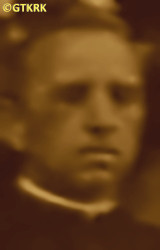
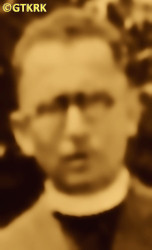
surname
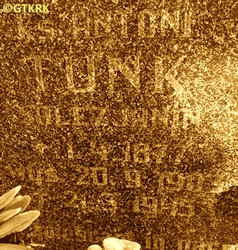
TUNK
forename(s)
Anthony (pl. Antoni)
function
religious cleric
creed
Latin (Roman Catholic) Church RCmore on
en.wikipedia.org
[access: 2014.09.21]
congregation
Society of St Francis de Sales SDBmore on
en.wikipedia.org
[access: 2013.05.19]
(i.e. Salesians of Don Bosco)
diocese / province
Wrocław archdiocesemore on
en.wikipedia.org
[access: 2013.05.19]
date and place
of death
19.03.1945

Koźle‐PortKoźle neighborhood
today: part of Kędzierzyn‐Koźle, Kędzierzyn‐Koźle urban gm., Kędzierzyn‐Koźle pov., Opole voiv., Poland
more on
en.wikipedia.org
[access: 2021.04.02]
alt. dates and places
of death
21.03.1945
details of death
At the end of World War II, which began with the German and Russian invasion of Poland in 09.1939, during the Russian winter offensive, which in 05.1945 led to the defeat of National Socialist Germany and the end of military operations in Europe — Kędzierzyn on the right bank of the Oder was captured by the Russians on 31.01.1945 (as part of the so‐called Vistula‐Oder Operation), while Koźle, including Koźle‐Port, on the left bank of the Oder, on 18.03.1945 (at the beginning of the so‐called Upper Silesian Operation).
The robberies and rapes on women started.
Perished stabbed with a bayonet or shot by the Russians — in defense of violated women.
Two days later, on 21.03.1945 the governance over the region passed from Russians to the Russian–sanctioned Polish Commie–Nazi authorities.
cause of death
murder
perpetrators
Russians
sites and events
Mass rapes in 1945Click to display the description, Ribbentrop‐MolotovClick to display the description, Pius XI's encyclicalsClick to display the description
date and place
of birth
01.04.1877

Krzanowicetoday: Krzanowice gm., Racibórz pov., Silesia voiv., Poland
more on
en.wikipedia.org
[access: 2025.10.15]
parents
TUNK Urban
🞲 ?, ? — 🕆 ?, ?

PIELA Genevieve
🞲 ?, ? — 🕆 ?, ?
baptism
03.04.1877

Krzanowicetoday: Krzanowice gm., Racibórz pov., Silesia voiv., Poland
more on
en.wikipedia.org
[access: 2025.10.15]
St Nicholas the Bishop and Confessor RC church
religious vows
1896 (temporary)
presbyter (holy orders)
ordination
20.09.1903

Turintoday: Turin city prov., Piedmont reg., Italy
more on
en.wikipedia.org
[access: 2020.11.01]
positions held
c. 1938 – 1945
resident — Koźletoday: part of Kędzierzyn‐Koźle, Kędzierzyn‐Koźle urban gm., Kędzierzyn‐Koźle pov., Opole voiv., Poland
more on
en.wikipedia.org
[access: 2021.04.02] ⋄ St Sigismund and St Hedwig of Silesia RC parish ⋄ Koźletoday: part of Kędzierzyn‐Koźle, Kędzierzyn‐Koźle urban gm., Kędzierzyn‐Koźle pov., Opole voiv., Poland
more on
en.wikipedia.org
[access: 2021.04.02] RC deanery — retired; also: chaplain of the Daughters of Charity FdlC chapel; chaplain at the chapel in a private home
c. 1938
friar — Waidhofen an der Ybbstoday: Waidhofen an der Ybbs dist., Lower Austria state, Austria
more on
en.wikipedia.org
[access: 2025.10.15] ⋄ Society's House, Salesians of Don Bosco SDB
1926 – 1936
friar — Viennatoday: Vienna state, Austria
more on
en.wikipedia.org
[access: 2020.07.31] ⋄ Salesianum Institute, Society's House (at 31 Haggenmüllergasse Str.), Salesians of Don Bosco SDB — i.a. confessor; released from monastery life in c. 1936 „due to illness”
c. 1921
priest — Koźletoday: part of Kędzierzyn‐Koźle, Kędzierzyn‐Koźle urban gm., Kędzierzyn‐Koźle pov., Opole voiv., Poland
more on
en.wikipedia.org
[access: 2021.04.02] — acting („ad interim”)
from c. 1920
friar — Fulpmestoday: Innsbruck‐Land dist., Tyrol state, Austria
more on
en.wikipedia.org
[access: 2025.10.15] ⋄ St Boniface Society's House, Salesians of Don Bosco SDB
from 12.1919
friar — Bambergtoday: Bamberg urban dist., Upper Franconia, reg., Bavaria state, Germany
more on
en.wikipedia.org
[access: 2022.08.05] ⋄ Society's House, Salesians of Don Bosco SDB
c. 1918
RC military chaplain — Austro–Hungarian Imperial Army — finished his service prob. in 1919, after the fall and disintegration of the Austro–Hungarian Empire
from 1913
friar — Viennatoday: Vienna state, Austria
more on
en.wikipedia.org
[access: 2020.07.31] ⋄ Salesianum Institute, Society's House (at 31 Haggenmüllergasse Str.), Salesians of Don Bosco SDB — i.a. confessor
till 1913
friar — Goriziatoday: Gorizia prov., Friuli Venezia Giulia reg., Italy
more on
en.wikipedia.org
[access: 2024.03.19] ⋄ St Louis Society's House, Salesians of Don Bosco SDB
from 1909
friar — Triestetoday: Trieste prov., Friuli Venezia Giulia reg., Italy
more on
en.wikipedia.org
[access: 2025.10.15] ⋄ Society's House, Salesians of Don Bosco SDB
1906 – 1909
friar — Goriziatoday: Gorizia prov., Friuli Venezia Giulia reg., Italy
more on
en.wikipedia.org
[access: 2024.03.19] ⋄ St Louis Society's House, Salesians of Don Bosco SDB
1905 – 1906
friar — Chioggatoday: Venice prov., Veneto reg., Italy
more on
en.wikipedia.org
[access: 2025.10.15] ⋄ Society's House, Salesians of Don Bosco SDB
1904 – 1905
friar — Viennatoday: Vienna state, Austria
more on
en.wikipedia.org
[access: 2020.07.31] ⋄ Society's House (at 3 Brückengasse Str.), Salesians of Don Bosco SDB
1898 – 1903
student — Penangotoday: Asti prov., Piedmont reg., Italy
more on
en.wikipedia.org
[access: 2025.10.15] ⋄ Theological Institute (higher theological seminary), Salesians of Don Bosco SDB
1895 – 1897
student — Ivreatoday: Turin prov., Piedmont reg., Italy
more on
en.wikipedia.org
[access: 2022.09.11] ⋄ Philosophical Institute (also known as the Philosophical Studentate), Salesians of Don Bosco SDB
21.09.1895 – 1896
novitiate — Ivreatoday: Turin prov., Piedmont reg., Italy
more on
en.wikipedia.org
[access: 2022.09.11] ⋄ Society's House, Salesians of Don Bosco SDB — robed on 08.12.1895
15.09.1895
accession — Turintoday: Turin city prov., Piedmont reg., Italy
more on
en.wikipedia.org
[access: 2020.11.01] ⋄ Society's House (Valsalice College), Salesians of Don Bosco SDB
sites and events
descriptions
Mass rapes in 1945: During capture in 1944‐1945 of pre‐war German territories and territories incorporated into Germany in 1939 after German invasion of Poland Russian soldiers committed mass, often multiple, rapes on mainly German, but also Polish, women. Up to 2 mln women might have been violated, from 8 to 80 or more years old. Many were murdered as a consequence. Rapes were prob. tolerated if not encouraged by Russian military and civilian NKVD commanders. (more on: en.wikipedia.orgClick to attempt to display webpage
[access: 2015.03.01])
Ribbentrop‐Molotov: Genocidal Russian‐German alliance pact between Russian leader Joseph Stalin and German leader Adolf Hitler signed on 23.08.1939 in Moscow by respective foreign ministers, Mr. Vyacheslav Molotov for Russia and Joachim von Ribbentrop for Germany. The pact sanctioned and was the direct cause of joint Russian and German invasion of Poland and the outbreak of the World War II in 09.1939. In a political sense, the pact was an attempt to restore the status quo ante before 1914, with one exception, namely the „commercial” exchange of the so‐called „Kingdom of Poland”, which in 1914 was part of the Russian Empire, fore Eastern Galicia (today's western Ukraine), in 1914 belonging to the Austro‐Hungarian Empire. Galicia, including Lviv, was to be taken over by the Russians, the „Kingdom of Poland” — under the name of the General Governorate — Germany. The resultant „war was one of the greatest calamities and dramas of humanity in history, for two atheistic and anti‐Christian ideologies — national and international socialism — rejected God and His fifth Decalogue commandment: Thou shall not kill!” (Abp Stanislav Gądecki, 01.09.2019). The decisions taken — backed up by the betrayal of the formal allies of Poland, France and Germany, which on 12.09.1939, at a joint conference in Abbeville, decided not to provide aid to attacked Poland and not to take military action against Germany (a clear breach of treaty obligations with Poland) — were on 28.09.1939 slightly altered and made more precise when a treaty on „German‐Russian boundaries and friendship” was agreed by the same murderous signatories. One of its findings was establishment of spheres of influence in Central and Eastern Europe and in consequence IV partition of Poland. In one of its secret annexes agreed, that: „the Signatories will not tolerate on its respective territories any Polish propaganda that affects the territory of the other Side. On their respective territories they will suppress all such propaganda and inform each other of the measures taken to accomplish it”. The agreements resulted in a series of meeting between two genocidal organization representing both sides — German Gestapo and Russian NKVD when coordination of efforts to exterminate Polish intelligentsia and Polish leading classes (in Germany called «Intelligenzaktion», in Russia took the form of Katyń massacres) where discussed. Resulted in deaths of hundreds of thousands of Polish intelligentsia, including thousands of priests presented here, and tens of millions of ordinary people,. The results of this Russian‐German pact lasted till 1989 and are still in evidence even today. (more on: en.wikipedia.orgClick to attempt to display webpage
[access: 2015.09.30])
Pius XI's encyclicals: Facing the creation of two totalitarian systems in Europe, which seemed to compete with each other, though there were more similarities than contradictions between them, Pope Pius XI issued in 03.1937 (within 5 days) two encyclicals. In the „Mit brennender Sorge” (Eng. „With Burning Concern”) published on 14.03.1938, condemned the national socialism prevailing in Germany. The Pope wrote: „Whoever, following the old Germanic‐pre‐Christian beliefs, puts various impersonal fate in the place of a personal God, denies the wisdom of God and Providence […], whoever exalts earthly values: race or nation, or state, or state system, representatives of state power or other fundamental values of human society, […] and makes them the highest standard of all values, including religious ones, and idolizes them, this one […] is far from true faith in God and from a worldview corresponding to such faith”. On 19.03.1937, published „Divini Redemptoris” (Eng. „Divine Redeemer”), in which criticized Russian communism, dialectical materialism and the class struggle theory. The Pope wrote: „Communism deprives man of freedom, and therefore the spiritual basis of all life norms. It deprives the human person of all his dignity and any moral support with which he could resist the onslaught of blind passions […] This is the new gospel that Bolshevik and godless communism preaches as a message of salvation and redemption of humanity”… Pius XI demanded that the established human law be subjected to the natural law of God , recommended the implementation of the ideal of a Christian state and society, and called on Catholics to resist. Two years later, National Socialist Germany and Communist Russia came together and started World War II. (more on: www.vatican.vaClick to attempt to display webpage
[access: 2023.05.28], www.vatican.vaClick to attempt to display webpage
[access: 2023.05.28])
sources
personal:
www.ssb24.plClick to attempt to display webpage
[access: 2013.05.19], www.k-k.plClick to attempt to display webpage
[access: 2021.12.19], nekropole.infoClick to attempt to display webpage
[access: 2015.09.30]
bibliographical:
„They gave testimony”, Joseph Gröger, 2015, Opole
original images:
kedzierzynkozle.grobonet.comClick to attempt to display webpage
[access: 2025.10.15]
LETTER to CUSTODIAN/ADMINISTRATOR
If you have an Email client on your communicator/computer — such as Mozilla Thunderbird, Windows Mail or Microsoft Outlook, described at WikipediaPatrz:
en.wikipedia.org, among others — try the link below, please:
LETTER to CUSTODIAN/ADMINISTRATORClick and try to call your own Email client
If however you do not run such a client or the above link is not active please send an email to the Custodian/Administrator using your account — in your customary email/correspondence engine — at the following address:

giving the following as the subject:
MARTYROLOGY: TUNK Anthony
To return to the biography press below:
 Click to return to biography