
Roman Catholic
St Sigismund parish
05-507 Słomczyn
85 Wiślana Str.
Konstancin deanery
Warsaw archdiocese, Poland

full list:
displayClick to display full list

searchClick to search full list by categories
wyświetlKliknij by wyświetlić pełną listę po polsku

szukajKliknij by przeszukać listę wg kategorii po polsku

Martyrology of the clergy — Poland
XX century (1914 – 1989)
personal data
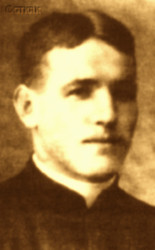
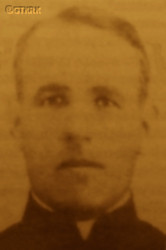
surname
TRZASKOMA
forename(s)
John (pl. Jan)
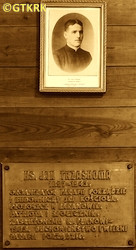
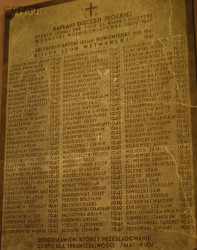
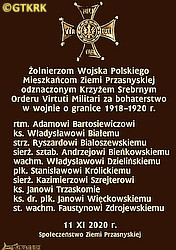
function
diocesan priest
creed
Latin (Roman Catholic) Church RCmore on
en.wikipedia.org
[access: 2014.09.21]
diocese / province
Płock diocesemore on
en.wikipedia.org
[access: 2013.05.19]
Warsaw archdiocesemore on
en.wikipedia.org
[access: 2013.05.19]
honorary titles
„Cross of Independence”more on
en.wikipedia.org
[access: 2019.02.02]
(05.08.1937)
„Polonia Restituta” Cross — 5th Class, Knight'smore on
en.wikipedia.org
[access: 2019.04.16]
(09.11.1932)
date and place
of death
20.03.1943

KL Dachauconcentration camp
today: Dachau, Upper Bavaria reg., Bavaria state, Germany
more on
en.wikipedia.org
[access: 2016.05.30]
details of death
Already as a 7‐year‐old boy, during the Russian occupation of partitioned Poland, distributed locally the illegal Polish conspiratorial „Polak” magazine.
In 10.1914, after the outbreak of World War I of 1914‐1918, joined the Polish Rifle Teams PDS — an organization legal in the Austrian partition of Poland, but illegal in the Russian partition. A year later, on 10.10.1915 — after the Russian defeat in the Battle of Gorlice in 05.1915, the panic retreat of the entire Russian partition apparatus from central Poland, known as „bezhenstvo”, and the beginning of the German occupation in Warsaw and its surroundings — joined the Polish Military Organization POW, a clandestine Polish organization existing in the years 1914‐1918, assuming the under nom de guerres „Kruk” and „Malczewski”. Graduated from a clandestine soldier's school, and then a POW non‐commissioned officer's school. Then trained POW cadres in Warsaw, and next in Jabłonna, Chotomów, Nowy Dwór Mazowiecki — that is, in his home regioni.
After the so‐called oath crisis, when the POW leader, Joseph Piłsudski, refused to swear an oath of allegiance to the German Empire and was arrested, he himself was arrested by the Germans and imprisoned for two weeks in the Citadel prison in Warsaw.
On 14.11.1918, after the end of the war, the return of Piłsudski to Warsaw and Poland regaining independence on 11.11.1918, took part, among other things, at the head of a POW platoon from his native Olszewnica, in the disarmament of the German garrison at the railway station in Nowa Jabłonna (today Legionowo).
At the end of 11.1918, joined the Polish Army as a volunteer.
During the Polish–Russian War of 1919‐1921, served in the ranks of the 1st Legions Infantry Regiment, which was being formed in Jabłonna, among other places. On 13.04.1919, the regiment was sent to Lida, where it took part in the battles for that town. On 17.04.1919, Lida was captured. Two days later, on 21.04.1919, Polish units — including the 1st Legions Regiment — attacked Vilnius, driving the Bolsheviks out.
Was injured at the time and stayed in hospital.
After recovering, went into the reserve and returned to the seminary in Warsaw.
When in 07.1920 a decisive Russian offensive approached the centre of Poland, threatening the independence of the reborn Republic of Poland, once again volunteered for the Polish Army. In the barracks in Legionowo, co‐organised the 3rd Battalion of the 201st Volunteer Infantry Regiment. On c. 08.07.1920, the battalion reached Łapy and deployed on the c. 6 km Uhowo‐Suraż section, along the Narew River. Defended it against Bolshevik attacks on 29‐31.07.1920, after which it began to withdraw. On 04.07.1920, took part in the lost battle of Paprocia and Pęchratka near Ostrów Mazowiecka. In continuous fighting, through Wyszków, the Regiment reached Kazuń Polski at the confluence of the Narew and Vistula rivers on 12.08.1920.
Already on 14.08.1920, at the beginning of the great counter–offensive of the Polish Army, which culminated in the Battle of Warsaw of c. 15.08.1920, rightly known as the „Miracle on the Vistula”, the Regiment was transferred to the village of Wrona, right by the Vistula tributary, the Wkra River. There, the next day, took part in a general attack on the Bolsheviks, commanded by Mikhail Tukhachevsky, in one of the most important battles of the war — the Battle of the Wkra — pushing the Russians to the eastern bank of the river, capturing, among others, the village of Cieksyn, and forcing them to retreat in an increasingly panic. Then, on 19‐20.08.1920, the Regiment took part in recapturing Ciechanów.
After resting, the Regiment was transferred to Grodno on 24.09.1920. After forcing the Russians to withdraw, entered that city. There, in the village of Kościołowszczyzna (today part of Grodno), was slightly wounded.
At that time, the regiment was included in the operational group of General Lucien Żeligowski. On 07.10.1920, General Żeligowski publicly announced a „mutiny” of his units, and on 08.10.1920 moved towards Vilnius, which had been occupied by Lithuanian troops since 26.08.1920 — pursuant to the Lithuanian–Bolshevik alliance concluded on 06.08.1920. Poland was not at war with Lithuania, however, hence General Żeligowski's „mutiny” was a solution that enabled the capture of Vilnius, inhabited in its vast majority by Poles, without formally breaking the rules set up by the victorious in World War I Western powers. General Żeligowski's troops — including the 201st Infantry Regiment, renamed the 2nd Vilnius Regiment — captured Vilnius and Trakai (including the village of Mikhnyshki, in which participated).
On 12.10.1920, General Żeligowski announced the creation of the so‐called Central Lithuania pseudo–state. On 18.10.1920, a ceasefire was declared in the Polish–Russian War. In 12/1920, the Regiment was demobilized, and the volunteers serving in it were transferred to the reserve and returned home. Returned then to the Warsaw theological seminary.
After German invasion of Poland on 01.09.1939 (Russians invaded Poland 17 days later) and start of the World War II, after start of German occupation, arrested by the Germans on 07.09.1939.
Released after a few days.
Arrested again by the Germans on 19.09.1939 and sent to a German farmer to slave on the fields.
Next jailed in KL Sachsenhausen concentration camp.
Finally on 14.12.1940 transported to KL Dachau concentration camp.
There perished — during trepanation of the skull surgery conducted by the German „doctors” due to ear infection.
According to the death certificate, prepared in KL Dachau, the „honest” otherwise German „medical doctors” and formalists — and at the same time, unrivaled fairy tale spinners — noted that the cause of death was Germ. „Versagen von Herz und Kreislauf, bei Sklerose der Kranzgefäße” (Eng. „Heart and circulatory failure, due to sclerosis of the coronary vessels”).
prisoner camp's numbers
22366Click to display source page (KL DachauClick to display the description)
cause of death
murder
perpetrators
Germans
sites and events
Medical experimentsClick to display the description, KL DachauClick to display the description, KL SachsenhausenClick to display the description, «Intelligenzaktion»Click to display the description, Ribbentrop‐MolotovClick to display the description, Pius XI's encyclicalsClick to display the description, Polish‐Russian war of 1919‐1921Click to display the description
date and place
of birth
02.12.1897Birth certification on:
skanoteka.genealodzy.pl
[access: 2025.08.19]


Olszewnica Nowatoday: Wieliszew gm., Legionowo pov., Masovia voiv., Poland
more on
en.wikipedia.org
[access: 2021.12.18]
parents
TRZASKOMA Francis
🞲 ?, ? — 🕆 ?, ?

MROZIK Catherine
🞲 ?, ? — 🕆 ?, ?
baptism
05.12.1897Birth certification on:
skanoteka.genealodzy.pl
[access: 2025.08.19]

Chotomówtoday: Jabłonna gm., Legionowo pov., Masovia voiv., Poland
more on
en.wikipedia.org
[access: 2025.03.16]
Assumption of the Blessed Virgin Mary RC church
presbyter (holy orders)
ordination
10.02.1924

Warsawtoday: Warsaw city pov., Masovia voiv., Poland
more on
en.wikipedia.org
[access: 2021.10.09]
positions held
1936 – 1939
parish priest — Baranowotoday: Baranowo gm., Ostrołęka pov., Masovia voiv., Poland
more on
en.wikipedia.org
[access: 2021.12.18] ⋄ Nativity of the Blessed Virgin Mary RC church ⋄ St Bartholomew the Apostle RC parish ⋄ Przasnysztoday: Przasnysz urban gm., Przasnysz pov., Masovia voiv., Poland
more on
en.wikipedia.org
[access: 2021.12.18] RC deanery
1927 – 1936
administrator — Porządzietoday: Rząśnik gm., Wyszków pov., Masovia voiv., Poland
more on
en.wikipedia.org
[access: 2021.12.18] ⋄ St Therese of the Child Jesus RC parish ⋄ Wyszkówtoday: Liw gm., Węgrów pov., Masovia voiv., Poland
more on
en.wikipedia.org
[access: 2021.12.18] RC deanery
1926 – 1927
vicar — Wyszkówtoday: Wyszków gm., Wyszków pov., Masovia voiv., Poland
more on
en.wikipedia.org
[access: 2021.12.18] ⋄ St Giles RC parish ⋄ Wyszkówtoday: Wyszków gm., Wyszków pov., Masovia voiv., Poland
more on
en.wikipedia.org
[access: 2021.12.18] RC deanery
1925 – 1926
vicar — Gostynintoday: Gostynin gm., Gostynin pov., Masovia voiv., Poland
more on
en.wikipedia.org
[access: 2021.12.18] ⋄ St Martin the Bishop and Confessor RC parish ⋄ Gostynintoday: Gostynin gm., Gostynin pov., Masovia voiv., Poland
more on
en.wikipedia.org
[access: 2021.12.18] RC deanery
1924 – 1925
vicar — Goszczyntoday: Goszczyn gm., Grójec pov., Masovia voiv., Poland
more on
en.wikipedia.org
[access: 2021.03.16] ⋄ St Michael the Archangel RC parish ⋄ Goszczyntoday: Goszczyn gm., Grójec pov., Masovia voiv., Poland
more on
en.wikipedia.org
[access: 2021.03.16] RC deanery
1917 – 1924
student — Warsawtoday: Warsaw city pov., Masovia voiv., Poland
more on
en.wikipedia.org
[access: 2021.10.09] ⋄ philosophy and theology, Metropolitan Theological Seminary
from 1913
student — Siennicatoday: Siennica gm., Mińsk Mazowiecki pov., Masovia voiv., Poland
more on
en.wikipedia.org
[access: 2021.12.18] ⋄ Teachers' Seminary
others related
in death
ANDRZEJCZAKClick to display biography Stanislav Kostka, BUKOWYClick to display biography Stanislav, DACHTERAClick to display biography Francis, FELCZAKClick to display biography Stanislav, GLISZCZYŃSKIClick to display biography Francis, JANECKIClick to display biography Mieczyslav, KAŁUŻAClick to display biography Joseph Marian, KŁOCZKOWSKIClick to display biography Mieczyslav John, KOCOTClick to display biography Joseph Francis, KOŁODZIEJClick to display biography Stanislav, KONOPIŃSKIClick to display biography Marian Vaclav, KULASIŃSKIClick to display biography Leo, LEŚNIEWICZClick to display biography Louis, LIGUDAClick to display biography Paul Louis, LISClick to display biography Thomas, ŁAGODAClick to display biography Leo, NOWICKIClick to display biography Casimir Alphonse, PAJDOClick to display biography Francis, RYGUSClick to display biography Leo, SEJBUKClick to display biography Ceslav, SEWIŁŁOClick to display biography Stanislav, STABRAWAClick to display biography Joseph, STACHOWSKIClick to display biography Bruno, STOPCZAKClick to display biography Marian Conrad, ZUSKEClick to display biography Stanislav Witold
sites and events
descriptions
Medical experiments: Criminal medical experiments conducted by German specialists on concentration camp inmates. Among tests, in KL Dachau, KL Auschwitz, KL Buchenwald and other camps, performed by German murderers were malaria injections, liver tests, injections of tuberculosis, typhoid, phlegmon germs, flying tests (in pressure chambers), blood crystallization and coagulation tests, hypothermia, sterilization, starvation tests, etc. (more on: pl.wikipedia.orgClick to attempt to display webpage
[access: 2012.11.23], en.wikipedia.orgClick to attempt to display webpage
[access: 2013.12.04])
KL Dachau: KL Dachau in German Bavaria, set up in 1933, became the main German Germ. Konzentrationslager (Eng. concentration camp) KL for Catholic priests and religious during World War II: On c. 09.11.1940, Reichsführer‐SS Heinrich Himmler, head of the SS, Gestapo and German police, as a result of the Vatican's intervention, decided to transfer all clergymen detained in various concentration camps to KL Dachau camp. The first major transports took place on 08.12.1940. In KL Dachau Germans held approx. 3,000 priests, including 1,800 Poles. The priests were forced to slave labor in the Germ. „Die Plantage” — the largest herb garden in Europe, managed by the genocidal SS, consisting of many greenhouses, laboratory buildings and arable land, where experiments with new natural medicines were conducted — for many hours, without breaks, without protective clothing, no food. They slaved in construction, e.g. of camp's crematorium. In the barracks ruled hunger, freezing cold in the winter and suffocating heat during the summer, especially acute in 1941‐1942. Prisoners suffered from bouts of illnesses, including tuberculosis. Many were victims of murderous „medical experiments” — in 11.1942 c. 20 were given phlegmon injections; in 07.1942 to 05.1944 c. 120 were used by for malaria experiments. More than 750 Polish clerics where murdered by the Germans, some brought to TA Hartheim euthanasia centre set up in Schloss Hartheim in Austria and murdered in gas chambers. At its peak KL Dachau concentration camps’ system had nearly 100 slave labour sub‐camps located throughout southern Germany and Austria. There were c. 32,000 documented deaths at the camp, and thousands perished without a trace. C. 10,000 of the 30,000 inmates were found sick at the time of liberation, on 29.04.1945, by the USA troops… (more on: www.kz-gedenkstaette-dachau.deClick to attempt to display webpage
[access: 2013.08.10], en.wikipedia.orgClick to attempt to display webpage
[access: 2016.05.30])
KL Sachsenhausen: In Germ. Konzentrationslager (Eng. concentration camp) KL Sachsenhausen, set up in the former Olympic village in 07.1936, hundreds of Polish priests were held in 1940, before being transported to KL Dachau. Some of them perished in KL Sachsenhausen. Murderous medical experiments on prisoners were carried out in the camp. In 1942‐1944 c. 140 prisoners slaved at manufacturing false British pounds, passports, visas, stamps and other documents. Other prisoners also had to do slave work, for Heinkel aircraft manufacturer, AEG and Siemens among others. On average c. 50,000 prisoners were held at any time. Altogether more than 200,000 inmates were in jailed in KL Sachsenhausen and its branched, out of which tens of thousands perished. Prior to Russian arrival mass evacuation was ordered by the Germans and c. 80,000 prisoners were marched west in so‐called „death marches” to other camps, i.e. KL Mauthausen‐Gusen and KL Bergen‐Belsen. The camp got liberated on 22.04.1945. After end of armed hostilities Germans set up there secret camp for German prisoners and „suspicious” Russian soldiers. (more on: en.wikipedia.orgClick to attempt to display webpage
[access: 2018.11.18])
«Intelligenzaktion»: German: «Intelligenzaktion» (English: „Intelligence Action”) — a German program of extermination of the Polish elite, mainly the intelligentsia and leadership layers, carried out from the beginning of the occupation in w 09.1939 to 04.1940, mainly in territories directly annexed to Germany, but also in the so‐called Germ. Generalgouvernement (Eng. General Governorate), where it was called «AB‐aktion». In the first phase, immediately after the beginning of the German occupation, during military operations carried out by the Germ. Wehrmacht (Eng. Armed Forces) and the genocidal units of the Germ. Einsatzgruppen (Eng. Operational Groups) of the Germ. Sicherheitspolizei (Eng. Security Police), i.e. SiPo, and Germ. Sicherheitsdienst des Reichsführers SS (Eng. Security Service of the Reichsführer SS), i.e. SD, organized by the Germ. Reichssicherheitshauptamt (Eng. Reich Main Security Office), i.e. RSHA, which followed the troops, carried out under the Germ. Unternehmen „Tannenberg” (Eng. Operation „Tannenberg”) — based on the so‐called Germ. Sonderfahndungsliste (Eng. Special Wanted Lists), i.e. proscription lists of Poles considered particularly dangerous to the Third Reich, prepared by the Zentralstelle II/P (Polen) unit of the German RSHA. Later, implemented by the German civilian occupation authorities and the genocidal unit of the Germ. Volksdeutscher Selbstschutz (Eng. Ethnic Germans Self‐Defense), whose members were Germ. Volksdeutsche (Eng. Ethnic Germans), i.e. representatives of the German minority in Poland. According to various sources, these lists, at the beginning of 09.1939, could have contained the details of 61,000—88,000 „dangerous” Poles — although these figures cannot be confirmed. In total, during this genocide, c. 50,000 teachers, Catholic priests, representatives of the landed gentry, freelancers, social and political activists, and retired military personnel were systematically and methodically murdered. Another 50,000 were sent to concentration camps, where only a negligible percentage survived. (more on: en.wikipedia.orgClick to attempt to display webpage
[access: 2014.10.04])
Ribbentrop‐Molotov: Genocidal Russian‐German alliance pact between Russian leader Joseph Stalin and German leader Adolf Hitler signed on 23.08.1939 in Moscow by respective foreign ministers, Mr. Vyacheslav Molotov for Russia and Joachim von Ribbentrop for Germany. The pact sanctioned and was the direct cause of joint Russian and German invasion of Poland and the outbreak of the World War II in 09.1939. In a political sense, the pact was an attempt to restore the status quo ante before 1914, with one exception, namely the „commercial” exchange of the so‐called „Kingdom of Poland”, which in 1914 was part of the Russian Empire, fore Eastern Galicia (today's western Ukraine), in 1914 belonging to the Austro‐Hungarian Empire. Galicia, including Lviv, was to be taken over by the Russians, the „Kingdom of Poland” — under the name of the General Governorate — Germany. The resultant „war was one of the greatest calamities and dramas of humanity in history, for two atheistic and anti‐Christian ideologies — national and international socialism — rejected God and His fifth Decalogue commandment: Thou shall not kill!” (Abp Stanislav Gądecki, 01.09.2019). The decisions taken — backed up by the betrayal of the formal allies of Poland, France and Germany, which on 12.09.1939, at a joint conference in Abbeville, decided not to provide aid to attacked Poland and not to take military action against Germany (a clear breach of treaty obligations with Poland) — were on 28.09.1939 slightly altered and made more precise when a treaty on „German‐Russian boundaries and friendship” was agreed by the same murderous signatories. One of its findings was establishment of spheres of influence in Central and Eastern Europe and in consequence IV partition of Poland. In one of its secret annexes agreed, that: „the Signatories will not tolerate on its respective territories any Polish propaganda that affects the territory of the other Side. On their respective territories they will suppress all such propaganda and inform each other of the measures taken to accomplish it”. The agreements resulted in a series of meeting between two genocidal organization representing both sides — German Gestapo and Russian NKVD when coordination of efforts to exterminate Polish intelligentsia and Polish leading classes (in Germany called «Intelligenzaktion», in Russia took the form of Katyń massacres) where discussed. Resulted in deaths of hundreds of thousands of Polish intelligentsia, including thousands of priests presented here, and tens of millions of ordinary people,. The results of this Russian‐German pact lasted till 1989 and are still in evidence even today. (more on: en.wikipedia.orgClick to attempt to display webpage
[access: 2015.09.30])
Pius XI's encyclicals: Facing the creation of two totalitarian systems in Europe, which seemed to compete with each other, though there were more similarities than contradictions between them, Pope Pius XI issued in 03.1937 (within 5 days) two encyclicals. In the „Mit brennender Sorge” (Eng. „With Burning Concern”) published on 14.03.1938, condemned the national socialism prevailing in Germany. The Pope wrote: „Whoever, following the old Germanic‐pre‐Christian beliefs, puts various impersonal fate in the place of a personal God, denies the wisdom of God and Providence […], whoever exalts earthly values: race or nation, or state, or state system, representatives of state power or other fundamental values of human society, […] and makes them the highest standard of all values, including religious ones, and idolizes them, this one […] is far from true faith in God and from a worldview corresponding to such faith”. On 19.03.1937, published „Divini Redemptoris” (Eng. „Divine Redeemer”), in which criticized Russian communism, dialectical materialism and the class struggle theory. The Pope wrote: „Communism deprives man of freedom, and therefore the spiritual basis of all life norms. It deprives the human person of all his dignity and any moral support with which he could resist the onslaught of blind passions […] This is the new gospel that Bolshevik and godless communism preaches as a message of salvation and redemption of humanity”… Pius XI demanded that the established human law be subjected to the natural law of God , recommended the implementation of the ideal of a Christian state and society, and called on Catholics to resist. Two years later, National Socialist Germany and Communist Russia came together and started World War II. (more on: www.vatican.vaClick to attempt to display webpage
[access: 2023.05.28], www.vatican.vaClick to attempt to display webpage
[access: 2023.05.28])
Polish‐Russian war of 1919‐1921: War for independence of Poland and its borders. Poland regained independence in 1918 but had to fight for its borders with former imperial powers, in particular Russia. Russia planned to incite Bolshevik‐like revolutions in the Western Europe and thus invaded Poland. Russian invaders were defeated in 08.1920 in a battle called Warsaw battle („Vistula river miracle”, one of the 10 most important battles in history, according to some historians). Thanks to this victory Poland recaptured part of the lands lost during partitions of Poland in XVIII century, and Europe was saved from the genocidal Communism. (more on: en.wikipedia.orgClick to attempt to display webpage
[access: 2014.12.20])
sources
personal:
pl.wikipedia.orgClick to attempt to display webpage
[access: 2012.12.28], mazowsze.hist.plClick to attempt to display webpage
[access: 2013.01.13], www.to.com.plClick to attempt to display webpage
[access: 2015.05.09], skanoteka.genealodzy.plClick to attempt to display webpage
[access: 2025.08.19], www.ipgs.usClick to attempt to display webpage
[access: 2012.11.23], mbc.cyfrowemazowsze.plClick to attempt to display webpage
[access: 2025.08.19]
bibliographical:
„Płock diocese clergy martyrology during II World War 1939‐1945”, Fr Nicholas Marian Grzybowski, Włocławek–Płock 2002
„Martyrology of the Polish Roman Catholic clergy under nazi occupation in 1939‐1945”, Victor Jacewicz, John Woś, vol. I‐V, Warsaw Theological Academy, 1977‐1981
„International Tracing Service (ITS), Bad Arolsen, GermanyClick to display source page”, Arolsen Archives
original images:
publiczna-szkola-podstawowa.cba.plClick to attempt to display webpage
[access: 2015.05.09], pl.wikipedia.orgClick to attempt to display webpage
[access: 2024.12.13], eprzasnysz.plClick to attempt to display webpage
[access: 2021.12.18], publiczna-szkola-podstawowa.cba.plClick to attempt to display webpage
[access: 2015.05.09]
LETTER to CUSTODIAN/ADMINISTRATOR
If you have an Email client on your communicator/computer — such as Mozilla Thunderbird, Windows Mail or Microsoft Outlook, described at WikipediaPatrz:
en.wikipedia.org, among others — try the link below, please:
LETTER to CUSTODIAN/ADMINISTRATORClick and try to call your own Email client
If however you do not run such a client or the above link is not active please send an email to the Custodian/Administrator using your account — in your customary email/correspondence engine — at the following address:

giving the following as the subject:
MARTYROLOGY: TRZASKOMA John
To return to the biography press below:
 Click to return to biography