
Roman Catholic
St Sigismund parish
05-507 Słomczyn
85 Wiślana Str.
Konstancin deanery
Warsaw archdiocese, Poland

full list:
displayClick to display full list

searchClick to search full list by categories
wyświetlKliknij by wyświetlić pełną listę po polsku

szukajKliknij by przeszukać listę wg kategorii po polsku

Martyrology of the clergy — Poland
XX century (1914 – 1989)
personal data
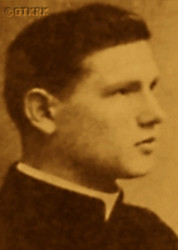
surname
TRUSS
forename(s)
Cyriac Boleslav (pl. Cyriak Bolesław)

function
diocesan priest
creed
Latin (Roman Catholic) Church RCmore on
en.wikipedia.org
[access: 2014.09.21]
diocese / province
Lutsk diocesemore on
en.wikipedia.org
[access: 2013.05.19]
Lutsk‐Zhytomyr diocese (aeque principaliter)more on
www.catholic-hierarchy.org
[access: 2021.12.19]
Siedlce diocesemore on
en.wikipedia.org
[access: 2022.01.06]
RC Military Ordinariate of Polandmore on
en.wikipedia.org
[access: 2014.12.20]
honorary titles
„Pro Ecclesia et Pontifice”more on
„Pro Ecclesia et Pontifice”
„Medal of Independence”more on
„Medal of Independence”
(16.09.1931)
Gold „Cross of Merit”more on
Gold „Cross of Merit”
(25.05.1939)
Silver „Cross of Merit”more on
Silver „Cross of Merit”
3rd of May Medalmore on
3rd of May Medal
„For Long Service” medalmore on
„For Long Service” medal
date and place
of death
12.07.1942

KL Dachauconcentration camp
today: Dachau, Upper Bavaria reg., Bavaria state, Germany
more on
en.wikipedia.org
[access: 2016.05.30]
details of death
During World War I, in 1917, began collaborating with a cell of the clandestine Polish Military Organization POW in Klewan.
After the end of World War I and Poland regaining its independence on 11.11.1918, after the conclusion of the Polish–Ukrainian War of 1918‐1919 in 07.1919, given the German withdrawal from the areas of the so‐called Ober‐Ost — i.e. the Lithuanian–Belarusian–Ukrainian lands, occupied by them since 1915 — they were being replaced by the advancing Russians. This caused the never–declared Polish–Russian War of 1919‐1921. In 1919, the newly created Polish Army attempted to reach the best strategic positions and level the front line before the expected large‐scale Russian offensive. In 08.1919, it undertook an offensive in Volyn. During it, on c. 10‐11.08.1919, it broke through the Russian defense line in the vicinity of Klevan and entered the town. Then, on 29.09.1919, became a chaplain of the Polish Army — prob. auxiliary. When at the end of 05.1920 the Russians — i.a. the Rus. Первая Конная армия (Eng. 1st Horse Army) under the command of General Semyon Budyonny — began the Russian offensive in Ukraine, breaking the so‐called Kiev expedition 04‐05.1920 front line, became chaplain of the 101st Infantry Regiment, within the 1st Reserve Infantry Brigade hastily being formed from 01.06.1920.
On 13.06.1920 the Regiment was in Zviahel, on the Sluch River, c. 120 km east of Klewan. On 27.06.1920, under Russian pressure, it began to retreat, through Slavuta, to Dubno, suffering heavy losses — it lost c. 1,000 soldiers, killed, wounded, missing. Through Brody was withdrawn to Ostrów Mazowiecka, where it spent 3 weeks reinforcing itself.
On 21.07.1920 was sent to Osowiec and Grajewo, by the Biebrza River, on the main line of attack of the Russian northern front under the command of General Mikhail Tukhachevsky, as part of the great offensive that began on 04.07.1920 on the Berezina River. Under pressure, it withdrew to Łomża, defence of which lasted 30.07‐03.08.1920. Next it defended the crossings over the Narew River in Dzbądz and near Pułtusk. On 12.08.1920 it was transferred to Nasielsk, where it defended the city, which was however occupied by the Russians the next day. Withdrew then to Modlin. After the beginning of the Polish counterattack from the Wieprz River, the key event of the great Battle of Warsaw (known as the „Miracle on the Vistula”), after Nasielsk was recaptured on 14–16.08.1920 and the collapse of the Russian offensive started, the Regiment struck north, towards Ciechanów, on 20.08.1920 capturing Przasnysz. From there it took part in pushing the Russians back, first towards Białystok and then Grodno. On 19.09.1920 it defended a position against a Russian counterattack near the village of Nowy Dwór, c. 20 km west of Grodno, capturing the village the next day. Then on 23‐26.09.1920 it took part in the battles for Grodno, which were part of the great Battle of the Neman River on 20‐26.09.1920. Next continued its pursuit of the Russians towards Lida — covering the northern flank of the Polish forces from the Lithuanians — and ended it in Varėna in Lithuania, where it organised the protection of the railway junction and where the Polish–Russian armistice found it. After the end of the war, remained in the military pastoral ministry.
At the end of 08.1939, during the general mobilization, appointed Dean — Head of the Pastoral Services — of the „Kraków” Army of the Polish Armed Forces.
Until the German (and also Slovak) invasion of Poland on 01.09.1939 (Russians invaded Poland 17 days later) and the start of World War II, did not manage to reach the headquarters of the assigned army (the army defended the section from Upper Silesia to Zakopane).
Joined her later in the Lublin region, after the army withdrew into Poland.
On 17‐19.09.1939 prob. took part in the battle of Tomaszów Lubelski, and after the defeat of the Polish army, was taken prisoner by the Germans on 20.09.1939.
Initially held in POW camp in Kraków, and next transported to the Oflag VII A Murnau POW camp.
From there moved to Oflag IX C Rotenburg an der Fulda POW camp for officers.
From there on 18.04.1940, in contravention of Geneva conventions of 27.07.1929, transported to KL Buchenwald concentration camp.
Finally on 06‐07.07.1942 moved to KL Dachau concentration camp where perished.
According to the death certificate, prepared in KL Dachau, the „honest” otherwise German „medical doctors” and formalists — and at the same time, unrivaled fairy tale spinners — noted that the cause of death was Germ. „Versagen von Herz und Kreislauf, bei Darmkatarrch” (Eng. „Heart and circulatory failure, due to intestinal catarrh”).
prisoner camp's numbers
31236Click to display source page (KL DachauClick to display the description), 1779Click to display source page (KL BuchenwaldClick to display the description)
cause of death
extermination: exhaustion and starvation
perpetrators
Germans
sites and events
KL DachauClick to display the description, KL BuchenwaldClick to display the description, Oflag IX C Rotenburg an der FuldaClick to display the description, Oflag VII A MurnauClick to display the description, Ribbentrop‐MolotovClick to display the description, Pius XI's encyclicalsClick to display the description, Polish‐Russian war of 1919‐1921Click to display the description
date and place
of birth
19.12.1890Birth certification on:
photos.szukajwarchiwach.gov.pl
[access: 2025.08.19]

Sawintoday: Sawin gm., Chełm pov., Lublin voiv., Poland
more on
en.wikipedia.org
[access: 2021.12.18]
parents
TRUSS Longinus
🞲 ?, ? — 🕆 ?, ?

DOROSZ Sophia
🞲 ?, ? — 🕆 ?, ?
baptism
06.01.1891Birth certification on:
photos.szukajwarchiwach.gov.pl
[access: 2025.08.19]

Sawintoday: Sawin gm., Chełm pov., Lublin voiv., Poland
more on
en.wikipedia.org
[access: 2021.12.18]
Transfiguration of the Lord RC church
presbyter (holy orders)
ordination
1915

positions held
from 08.1939
RC senior military chaplain — „Kraków” Army, Polish Armed Forces — acting („ad interim”) dean, head of pastoral ministry
01.10.1924 – 1939
RC senior military chaplain — Dęblintoday: Dęblin urban gm., Ryki pov., Lublin voiv., Poland
more on
en.wikipedia.org
[access: 2021.12.18] ⋄ garrison, Corps District OK No. I Warsaw, Polish Armed Forces ⋄ St Michael the Archangel RC garrison church ⋄ St Pius V RC parish — promotion by order of the President of the Republic of Poland of 04.02.1934, with seniority from 01.01.1934 and 6th place among the senior chaplains of the military Roman Catholic clergy, in the rank of major; also: chaplain of the 15th „Wolves” Infantry Regiment, stationed in Dęblin; 28th Light Artillery Regiment, stationed in Zajezierze n. Dęblin; and aviation units stationed in Dęblin from 1927; administrator of the military parish
03.06.1922 – 01.10.1924
RC military chaplain — Kutno i ŁęczycaPolish Army garrisons' seats
today: Łódź voiv., Poland ⋄ garrison, Corps District OK No. IV Łódź, Polish Armed Forces — also: chaplain of the Łęczyca Region 37th Infantry Regiment, stationed in Kutno
15.01.1921 – 03.06.1922
RC military chaplain — Starogard Gdańskitoday: Starogard Gdański gm., Starogard Gdański pov., Pomerania voiv., Poland
more on
en.wikipedia.org
[access: 2021.06.07] ⋄ garrison, Corps District OK No. VIII Toruń (till 15.11.1921 General District OG „Pomerania”), Polish Armed Forces — commissioned; by decree of the Chief of State of ‐03.05.1922, confirmed with seniority from 01.06.1919 and 49th place on the list of Roman Catholic military chaplains, in the rank of captain; by decree No. L. 3448 of the Commander‐in‐Chief of 16.12.1921, verified with seniority from 01.04.1920 and 48th place on the list of Roman Catholic military chaplains, in the rank of captain
29.09.1919 – 15.01.1921
RC military chaplain — 101st Infantry Regiment, Polish Armed Forces
c. 1919 – 1920
administrator — Klevantoday: Klevan hrom., Rivne rai., Rivne obl., Ukraine
more on
en.wikipedia.org
[access: 2021.09.17] ⋄ Annunciation to the Blessed Virgin Mary RC parish ⋄ Rivnetoday: Rivne urban hrom., Rivne rai., Rivne obl., Ukraine
more on
en.wikipedia.org
[access: 2021.09.17] RC deanery
till c. 1918
vicar — Proskurivtoday: Khmelnytskyi, Proskuriv/Khmelnytskyi urban hrom., Proskuriv/Khmelnytskyi rai., Proskuriv/Khmelnytskyi obl., Ukraine
more on
en.wikipedia.org
[access: 2020.11.27] ⋄ Immaculate Conception of the Blessed Virgin Mary RC parish ⋄ Proskurivtoday: Khmelnytskyi, Proskuriv/Khmelnytskyi urban hrom., Proskuriv/Khmelnytskyi rai., Proskuriv/Khmelnytskyi obl., Ukraine
more on
en.wikipedia.org
[access: 2020.11.27] RC deanery
1910 – 1915
student — Zhytomyrtoday: Zhytomyr urban hrom., Zhytomyr rai., Zhytomyr obl., Ukraine
more on
en.wikipedia.org
[access: 2021.09.17] ⋄ philosophy and theology, Theological Seminary
others related
in death
BELONClick to display biography Zdislav Anthony, BRYDACKIClick to display biography Louis Cyprian, DACHTERAClick to display biography Francis, DRWALClick to display biography Francis, FRANCUZClick to display biography John, GÓRALIKClick to display biography John, JĘDRYSIKClick to display biography Severin (Fr Vincent Mary), KLARZAKClick to display biography Joseph, KRYŃSKIClick to display biography Adolph Bernard, LISSOWSKIClick to display biography Ceslav Joseph, MICHUŁKAClick to display biography John, MIEGOŃClick to display biography Vladislav, STOPCZAKClick to display biography Marian Conrad, SYPERClick to display biography Stanislav, SZABELSKIClick to display biography Edward Bronislav, ŚWIDEREKClick to display biography Vladislav, TOMIAKClick to display biography Joseph, ZAKRZEWSKIClick to display biography John, ZIEMIAŃSKIClick to display biography Michael Urban, ZIĘBAClick to display biography Adalbert
sites and events
descriptions
KL Dachau: KL Dachau in German Bavaria, set up in 1933, became the main German Germ. Konzentrationslager (Eng. concentration camp) KL for Catholic priests and religious during World War II: On c. 09.11.1940, Reichsführer‐SS Heinrich Himmler, head of the SS, Gestapo and German police, as a result of the Vatican's intervention, decided to transfer all clergymen detained in various concentration camps to KL Dachau camp. The first major transports took place on 08.12.1940. In KL Dachau Germans held approx. 3,000 priests, including 1,800 Poles. The priests were forced to slave labor in the Germ. „Die Plantage” — the largest herb garden in Europe, managed by the genocidal SS, consisting of many greenhouses, laboratory buildings and arable land, where experiments with new natural medicines were conducted — for many hours, without breaks, without protective clothing, no food. They slaved in construction, e.g. of camp's crematorium. In the barracks ruled hunger, freezing cold in the winter and suffocating heat during the summer, especially acute in 1941‐1942. Prisoners suffered from bouts of illnesses, including tuberculosis. Many were victims of murderous „medical experiments” — in 11.1942 c. 20 were given phlegmon injections; in 07.1942 to 05.1944 c. 120 were used by for malaria experiments. More than 750 Polish clerics where murdered by the Germans, some brought to TA Hartheim euthanasia centre set up in Schloss Hartheim in Austria and murdered in gas chambers. At its peak KL Dachau concentration camps’ system had nearly 100 slave labour sub‐camps located throughout southern Germany and Austria. There were c. 32,000 documented deaths at the camp, and thousands perished without a trace. C. 10,000 of the 30,000 inmates were found sick at the time of liberation, on 29.04.1945, by the USA troops… (more on: www.kz-gedenkstaette-dachau.deClick to attempt to display webpage
[access: 2013.08.10], en.wikipedia.orgClick to attempt to display webpage
[access: 2016.05.30])
KL Buchenwald: In German Germ. Konzentrationslager (Eng. concentration camp) KL Buchenwald concentration camp, founded in 1937 and operational till 1945, Germans held c. 238,380 prisoners and murdered approx. 56,000 of them, among them thousands of Poles. Prisoners were victims of pseudo‐scientific experiments, conducted among others by Behring‐Werke from Marburg and Robert Koch Institute from Berlin companies. They slaved for Gustloff in Weimar and Fritz‐Sauckel companies manufacturing armaments. To support Erla‐Maschinenwerk GmbH in Leipzig, Junkers in Schönebeck (airplanes) and Rautal in Wernigerode Germans organized special sub‐camps. In 1945 there were more than 100 such sub‐camps. Dora concentration camp was initially one of them, as well as KL Ravensbrück sub‐camps (from 08.1944). On 08.04.1945 Polish prisoner, Mr Guido Damazyn, used clandestinely constructed short wave transmitter to sent, together with a Russian prisoner, a short message begging for help. It was received and he got a reply: „KZ Bu. Hold out. Rushing to your aid. Staff of Third Army” (American). Three days later the camp was liberated. (more on: www.buchenwald.deClick to attempt to display webpage
[access: 2013.08.10], en.wikipedia.orgClick to attempt to display webpage
[access: 2013.08.10])
Oflag IX C Rotenburg an der Fulda: German POW prisoner of war camp for officers in Rotenburg an der Fulda in Hesse. C. 60‐70 Polish Catholic priests, most of them military chaplains, captured by the Germans in 09.1939 during German invasion of Poland, were held POW there from 12.1939. In preparations for invasion of France all on 18.04.1940 were sent — in contravention of Geneva conventions of 27.07.1929 — to KL Buchenwald concentration camps. From 06.1940 Germ. Zweiglager (Eng. sub‐camp) of Oflag IX A/H Spangenberg and renamed Oflag IX A/Z. (more on: en.wikipedia.orgClick to attempt to display webpage
[access: 2019.11.17])
Oflag VII A Murnau: German POW camp for Polish officers in Murnau am Staffelsee in Bavaria, set up in 09.1939 (first POW were brought in on 06.10.1939). Up to of 5,457 (including 5,114 Poles and among them at least 31 generals) were held POW there. The camp was established in barracks — built in 1939 for c. 600 soldiers — which were practically unfinished until the end of the camp's operation. As the numbers in the camp increased, attics and basements in residential buildings and garages were converted into rooms. The camp was liberated on 29.04.1945 by a unit of American troops. (more on: en.wikipedia.orgClick to attempt to display webpage
[access: 2019.11.17])
Ribbentrop‐Molotov: Genocidal Russian‐German alliance pact between Russian leader Joseph Stalin and German leader Adolf Hitler signed on 23.08.1939 in Moscow by respective foreign ministers, Mr. Vyacheslav Molotov for Russia and Joachim von Ribbentrop for Germany. The pact sanctioned and was the direct cause of joint Russian and German invasion of Poland and the outbreak of the World War II in 09.1939. In a political sense, the pact was an attempt to restore the status quo ante before 1914, with one exception, namely the „commercial” exchange of the so‐called „Kingdom of Poland”, which in 1914 was part of the Russian Empire, fore Eastern Galicia (today's western Ukraine), in 1914 belonging to the Austro‐Hungarian Empire. Galicia, including Lviv, was to be taken over by the Russians, the „Kingdom of Poland” — under the name of the General Governorate — Germany. The resultant „war was one of the greatest calamities and dramas of humanity in history, for two atheistic and anti‐Christian ideologies — national and international socialism — rejected God and His fifth Decalogue commandment: Thou shall not kill!” (Abp Stanislav Gądecki, 01.09.2019). The decisions taken — backed up by the betrayal of the formal allies of Poland, France and Germany, which on 12.09.1939, at a joint conference in Abbeville, decided not to provide aid to attacked Poland and not to take military action against Germany (a clear breach of treaty obligations with Poland) — were on 28.09.1939 slightly altered and made more precise when a treaty on „German‐Russian boundaries and friendship” was agreed by the same murderous signatories. One of its findings was establishment of spheres of influence in Central and Eastern Europe and in consequence IV partition of Poland. In one of its secret annexes agreed, that: „the Signatories will not tolerate on its respective territories any Polish propaganda that affects the territory of the other Side. On their respective territories they will suppress all such propaganda and inform each other of the measures taken to accomplish it”. The agreements resulted in a series of meeting between two genocidal organization representing both sides — German Gestapo and Russian NKVD when coordination of efforts to exterminate Polish intelligentsia and Polish leading classes (in Germany called «Intelligenzaktion», in Russia took the form of Katyń massacres) where discussed. Resulted in deaths of hundreds of thousands of Polish intelligentsia, including thousands of priests presented here, and tens of millions of ordinary people,. The results of this Russian‐German pact lasted till 1989 and are still in evidence even today. (more on: en.wikipedia.orgClick to attempt to display webpage
[access: 2015.09.30])
Pius XI's encyclicals: Facing the creation of two totalitarian systems in Europe, which seemed to compete with each other, though there were more similarities than contradictions between them, Pope Pius XI issued in 03.1937 (within 5 days) two encyclicals. In the „Mit brennender Sorge” (Eng. „With Burning Concern”) published on 14.03.1938, condemned the national socialism prevailing in Germany. The Pope wrote: „Whoever, following the old Germanic‐pre‐Christian beliefs, puts various impersonal fate in the place of a personal God, denies the wisdom of God and Providence […], whoever exalts earthly values: race or nation, or state, or state system, representatives of state power or other fundamental values of human society, […] and makes them the highest standard of all values, including religious ones, and idolizes them, this one […] is far from true faith in God and from a worldview corresponding to such faith”. On 19.03.1937, published „Divini Redemptoris” (Eng. „Divine Redeemer”), in which criticized Russian communism, dialectical materialism and the class struggle theory. The Pope wrote: „Communism deprives man of freedom, and therefore the spiritual basis of all life norms. It deprives the human person of all his dignity and any moral support with which he could resist the onslaught of blind passions […] This is the new gospel that Bolshevik and godless communism preaches as a message of salvation and redemption of humanity”… Pius XI demanded that the established human law be subjected to the natural law of God , recommended the implementation of the ideal of a Christian state and society, and called on Catholics to resist. Two years later, National Socialist Germany and Communist Russia came together and started World War II. (more on: www.vatican.vaClick to attempt to display webpage
[access: 2023.05.28], www.vatican.vaClick to attempt to display webpage
[access: 2023.05.28])
Polish‐Russian war of 1919‐1921: War for independence of Poland and its borders. Poland regained independence in 1918 but had to fight for its borders with former imperial powers, in particular Russia. Russia planned to incite Bolshevik‐like revolutions in the Western Europe and thus invaded Poland. Russian invaders were defeated in 08.1920 in a battle called Warsaw battle („Vistula river miracle”, one of the 10 most important battles in history, according to some historians). Thanks to this victory Poland recaptured part of the lands lost during partitions of Poland in XVIII century, and Europe was saved from the genocidal Communism. (more on: en.wikipedia.orgClick to attempt to display webpage
[access: 2014.12.20])
sources
personal:
michaelstanislaus.salon24.plClick to attempt to display webpage
[access: 2012.06.01], www.duszki.plClick to attempt to display webpage
[access: 2012.11.23], archiwum-ordynariat.wp.mil.plClick to attempt to display webpage
[access: 2022.07.05], photos.szukajwarchiwach.gov.plClick to attempt to display webpage
[access: 2025.08.19], www.ipgs.usClick to attempt to display webpage
[access: 2012.11.23]
bibliographical:
„Martyrology of the Polish Roman Catholic clergy under nazi occupation in 1939‐1945”, Victor Jacewicz, John Woś, vol. I‐V, Warsaw Theological Academy, 1977‐1981
„Register of Latin rite Lviv metropolis clergy’s losses in 1939‐45”, Józef Krętosz, Maria Pawłowiczowa, editors, Opole, 2005
„Biographical lexicon of Lviv Roman Catholic Metropoly clergy victims of the II World War 1939‐1945”, Mary Pawłowiczowa (ed.), Fr Joseph Krętosz (ed.), Holy Cross Publishing, Opole, 2007
„Parish priest of Lutsk–Żhytomyr 1801‐1920 and Kamyanets–Podilskyi 1869‐1919 dioceses”, Fr Waldemar Witold Żurek SDB, Lublin 2023
„International Tracing Service (ITS), Bad Arolsen, GermanyClick to display source page”, Arolsen Archives
original images:
www.katedrapolowa.plClick to attempt to display webpage
[access: 2014.01.16]
LETTER to CUSTODIAN/ADMINISTRATOR
If you have an Email client on your communicator/computer — such as Mozilla Thunderbird, Windows Mail or Microsoft Outlook, described at WikipediaPatrz:
en.wikipedia.org, among others — try the link below, please:
LETTER to CUSTODIAN/ADMINISTRATORClick and try to call your own Email client
If however you do not run such a client or the above link is not active please send an email to the Custodian/Administrator using your account — in your customary email/correspondence engine — at the following address:

giving the following as the subject:
MARTYROLOGY: TRUSS Cyriac Boleslav
To return to the biography press below:
 Click to return to biography