
Roman Catholic
St Sigismund parish
05-507 Słomczyn
85 Wiślana Str.
Konstancin deanery
Warsaw archdiocese, Poland



full list:
displayClick to display full list

searchClick to search full list by categories
wyświetlKliknij by wyświetlić pełną listę po polsku

szukajKliknij by przeszukać listę wg kategorii po polsku

Martyrology of the clergy — Poland
XX century (1914 – 1989)
personal data

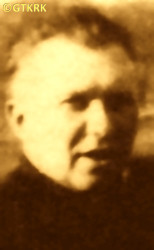
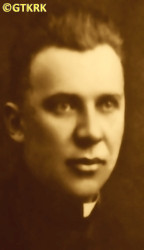
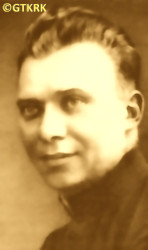
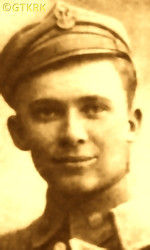

religious status
Servant of God
surname
TOMAKA
forename(s)
Martin (pl. Marcin)

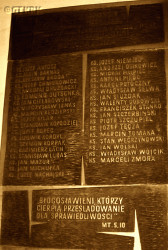
function
diocesan priest
creed
Latin (Roman Catholic) Church RCmore on
en.wikipedia.org
[access: 2014.09.21]
diocese / province
Przemyśl diocesemore on
www.przemyska.pl
[access: 2013.02.15]
honorary titles
Expositorii Canonicalis canonmore on
Expositorii Canonicalis canon
(c. 1936)
„Cross of Independence”more on
„Cross of Independence”
(09.01.1932)
Gold „Cross of Merit”more on
Gold „Cross of Merit”
(15.09.1938)
War Order of Virtuti Militarimore on
War Order of Virtuti Militari
date and place
of death
08.07.1942

KL Dachauconcentration camp
today: Dachau, Upper Bavaria reg., Bavaria state, Germany
more on
en.wikipedia.org
[access: 2016.05.30]
details of death
After the outbreak of World War I of 1914‐1918, joined the Polish Legions, formed within the Army of the Austro–Hungarian Monarchy. Was to serve in the 2nd Infantry Regiment throughout the entire combat trail of that formation.
Twice wounded.
After the German and Russian invasion of Poland in 09.1939 and start of the World War II, after start of German occupation, supported his parishioners spiritually, morally, and financially. Publicly called attention to the immoral behavior of German soldiers. Refused to give them quarters in the rectory.
Arrested by the Germans on 19.06.1940.
Held in prison in Sanok.
On 09.08.1940, transferred to the prison in Tarnów.
On 29.09.1940, called out his cell, placed in the prison yard, and then, along with several hundred other prisoners, most of whom had undergone interrogation and torture in prison, taken to the railway station. There loaded onto a freight car, which was then locked and bolted, and had windows boarded up. The train stopped once, in Kraków, when a single car carrying 25 prisoners brought from the prison on Montelupich Str. was added to it. In the evening, the transport‐it was the second such transport from Tarnów‐carrying 413 men, reached the German KL Auschwitz concentration camp, already located outside the Germ. Generalgouvernement (Eng. General Governorate), in the Germ. Provinz Schlesien (Eng. Province of Silesia), which, after the beginning of the German occupation, was directly incorporated into the German Reich.
Finally, on 12.12.1940 transferred to KL Dachau concentration camp where was tortured, maltreated and famished and where perished.
According to the death certificate, prepared in KL Dachau, the „honest” otherwise German „medical doctors” and formalists — and at the same time, unrivaled fairy tale spinners — noted that the cause of death was Germ. „Versagen von Herz und Kreislauf, bei Darmkatarrch” (Eng. „Heart and circulatory failure, due to intestinal catarrh”).
prisoner camp's numbers
22242Click to display source page (KL DachauClick to display the description), 3319Click to display source page (KL AuschwitzClick to display the description)
cause of death
extermination: exhaustion and starvation
perpetrators
Germans
sites and events
KL DachauClick to display the description, KL AuschwitzClick to display the description, Regierungsbezirk KattowitzClick to display the description, DZ Neu‐WisnitzClick to display the description, TarnówClick to display the description, SanokClick to display the description, GeneralgouvernementClick to display the description, Ribbentrop‐MolotovClick to display the description, Pius XI's encyclicalsClick to display the description
date and place
of birth
15.05.1894Birth certification on:
photos.szukajwarchiwach.gov.pl
[access: 2025.03.18]

Krasnetoday: Krasne gm., Rzeszów pov., Subcarpathia voiv., Poland
more on
en.wikipedia.org
[access: 2021.10.09]
parents
TOMAKA Martin
🞲 ?, ? — 🕆 ?, ?

LECH Thecla
🞲 1852, ? — 🕆 ?, ?
baptism
17.05.1894Birth certification on:
photos.szukajwarchiwach.gov.pl
[access: 2025.03.18]

Krasnetoday: Krasne gm., Rzeszów pov., Subcarpathia voiv., Poland
more on
en.wikipedia.org
[access: 2021.10.09]
Assumption of the Blessed Virgin Mary RC church
presbyter (holy orders)
ordination
11.06.1922

Przemyśltoday: Przemyśl city pov., Subcarpathia voiv., Poland
more on
en.wikipedia.org
[access: 2021.04.01]
Assumption of the Blessed Virgin Mary and St John the Baptist RC cathedral churchmore on
en.wikipedia.org
[access: 2025.03.14]
positions held
1934 – 1940
parish priest — Haczówtoday: Haczów gm., Brzozów pov., Subcarpathia voiv., Poland
more on
en.wikipedia.org
[access: 2021.10.09] ⋄ Assumption of the Blessed Virgin Mary RC parish ⋄ Rymanówtoday: Rymanów gm., Krosno pov., Subcarpathia voiv., Poland
more on
en.wikipedia.org
[access: 2021.10.09] RC deanery — builder of a new church
1929 – 1934
General secretary — Catholic Association of Women's Youth ⋄ Przemyśl RC diocese
1927 – 1929
vicar — Przemyśltoday: Przemyśl city pov., Subcarpathia voiv., Poland
more on
en.wikipedia.org
[access: 2021.04.01] ⋄ Assumption of the Blessed Virgin Mary and St John the Baptist RC cathedral parish ⋄ Przemyśl citydeanery name
today: Przemyśl city pov., Subcarpathia voiv., Poland RC deanery
1926 – 1927
vicar — Kobylanytoday: Chorkówka gm., Krosno pov., Subcarpathia voiv., Poland
more on
en.wikipedia.org
[access: 2021.10.09] ⋄ Nativity of the Blessed Virgin Mary RC parish ⋄ Duklatoday: Dukla gm., Krosno pov., Subcarpathia voiv., Poland
more on
en.wikipedia.org
[access: 2021.10.09] RC deanery
1926
administrator — Krzywczatoday: Krzywcza gm., Przemyśl pov., Subcarpathia voiv., Poland
more on
en.wikipedia.org
[access: 2021.10.09] ⋄ Nativity of the Blessed Virgin Mary RC parish ⋄ Przemyśl suburbsdeanery name
today: Przemyśl city pov., Subcarpathia voiv., Poland RC deanery
1925
administrator — Leżajsktoday: Leżajsk urban gm., Leżajsk pov., Subcarpathia voiv., Poland
more on
en.wikipedia.org
[access: 2021.10.09] ⋄ Holy Trinity, Blessed Virgin Mary and All the Saints RC parish ⋄ Leżajsktoday: Leżajsk urban gm., Leżajsk pov., Subcarpathia voiv., Poland
more on
en.wikipedia.org
[access: 2021.10.09] RC deanery
1925
vicar — Leżajsktoday: Leżajsk urban gm., Leżajsk pov., Subcarpathia voiv., Poland
more on
en.wikipedia.org
[access: 2021.10.09] ⋄ Holy Trinity, Blessed Virgin Mary and All the Saints RC parish ⋄ Leżajsktoday: Leżajsk urban gm., Leżajsk pov., Subcarpathia voiv., Poland
more on
en.wikipedia.org
[access: 2021.10.09] RC deanery
1922 – 1925
vicar — Sokołów Małopolskitoday: Sokołów Małopolski gm., Rzeszów pov., Subcarpathia voiv., Poland
more on
en.wikipedia.org
[access: 2021.10.09] ⋄ St John the Baptist RC parish ⋄ Sokołów Małopolskitoday: Sokołów Małopolski gm., Rzeszów pov., Subcarpathia voiv., Poland
more on
en.wikipedia.org
[access: 2021.10.09] RC deanery
1918 – 1922
student — Przemyśltoday: Przemyśl city pov., Subcarpathia voiv., Poland
more on
en.wikipedia.org
[access: 2021.04.01] ⋄ philosophy and theology, Theological Seminary
comments
After the outbreak of the World War I, the 2nd Infantry Regiment of the Polish Legions was sent in 10.1914 to Hungary, to the Carpathian Front and the town of Sygheit Marmatiei. The Carpathian Arc became a front line in the fights between Austria–Hungary and Russia, after the Russians pushed the Austro–Hungarian troops out of Eastern Galicia, part of the crown land of the Germ. Königreich Galizien und Lodomerien (Eng. Kingdom of Galicia and Lodomeria). In Sygheit Marmatiei (today Romania), on the western side of the Carpathians, Russian Cossacks were on the prowl. The Regiment managed to repell and push them back. Then it crossed the Pantyrska Pass, in the Gorgan range in the eastern Carpathians, and went along the Nadvirna Bystrytsya river valley (towards Stanislaviv), capturing Rafailivka, Zelena, Pasichna, and on 24.10.1914 Nadvirna. After a skirmish near Nazavyziv, it took part in a lost battle near Molodkiv near Nadvirna on 29.10.1914. For the next month, it defended the captured positions along the Bystrytsya River. On 26.11.1914, it was transferred to the town of Zhabe in Hutsulshchyna, in the Carpathian Chornohora range. After several days of fighting, the Regiment was transferred c. 120 km to the north–west, back to Transcarpathia, on the eastern edge of the Eastern Bieszczady Mountains. There, it took part in heavy fighting in the Volove Pole triangle. (today Mizhhirya) – Csushka – Maydanka (today Maydan). Particularly fierce battles were fought for control of Kleva Mountain. Then the Regiment was transferred to Southern Bukovina, to the eastern section of the Carpathian Front, where the Russians began a dynamic offensive. There — „at an altitude of 1,700 meters, amidst snowstorms, in twenty–degree frost, trudging through snow up to their knees, in an area devoid of quarters, with frequent bivouacs in the open air, where the guards often froze to death in their positions” — it took part in the Battle of Cârlibaba on 18‐22.01.1915. The victory thwarted the Russians' plans and opened the way to central Bukovina and back to Eastern Galicia. In a combat march of over 100 km north, the Regiment — through the Breaza, Moldova, Lopushna villages — reached Snyatyn on the Prut. From there it was transported to the Tlumach–Nyzhniv line, about 25 km east of Stanislaviv, which was retaken by the Austrians on 20.02.1915. There it took part in defensive battles with the Russians on 03.03.1915, ultimately holding Tlumach. On 15.03.1915 the regiment went to Kolomyia for a rest.
In 04.1915 the Regiment was transferred to the front of the battles, near the village of Dobrynivtsi in Bessarabia. There on 10.05.1915 the Russians, after a local breakthrough of the front, surrounded the Regiment and forced it to withdraw south, beyond the Prut River. The 2nd Battalion was almost completely wiped out, and many soldiers died in the Prut River. Then from 08.06.1915, in offensive battles referred to as the Bukovina Offensive, after once again crossing to the left bank of the Prut, the Regiment advanced about 30 km to the east, through Mamaivtsi and Zadubrivka, reaching Rokitna. Was there when on 13.06.1915 the 2nd Squadron charged — in about 13 minutes the uhlans broke through the three Russian lines of trenches. The commander of the shadron, Capt. Zbigniew Dunin–Wąsowicz, lost his life. Two days later, the Regiment withdrew 10 km to the west, to Radkivci. There, it repelled a Russian counterattack, taking over 1,000 prisoners.
These battles earned the entire 2nd Legions Brigade the nickname of the „Carpathian Iron Brigade”.
A 4‐month period of calm, life in the trenches, followed. At that time, on the Galician front, after the Russian defeat on 03.05.1915 near Gorlice, Germany and Austria–Hungary broke through the front, forcing the Russians to retreat increasingly quickly to the east, and causing a panicky escape of c. 3 million Russian officials, teachers, military supporters, Orthodox clergy from the occupied territories of the Poland into the depths of Russia, known as bezhenstvo.
In c. 10.1915, the Polish Legions were concentrated on the Styr River in Volhynia, about 70 km north of Lutsk, taking over responsibility for part of the front line, which had settled there. Bloody battles continued until 12.1915, i.a. on 07‐08.11.1915, the battle of Lisov in Volyn (also known as the Battle of Bielgov) took place, after which the front stabilized in positional fighting for about half a year.
On 04.06.1916, the biggest offensive of the Imperial Russian Army against the armies of the Central Powers during World War I, known as the Brusilov Offensive, began. The main direction of attack in the north was Kovel, and then Lviv (in the south Lviv and Stanislaviv). The Legions found themselves on the strategic line of the Russian attack. On 20‐21.06.1915, the 2nd Regiment defended the position near Hruzyatyn, after which it was transferred north to Haluziya, where it took part in the largest battle fought by the Polish Legions, near Kostyukhnivka, on 05‐06.07.1915 — on the left wing of the Polish defence line. The Legions tactically lost the battle — 5,500 Polish soldiers held back the attack of 13,000 Russians — but they prevented the front from collapsing on the defended section — at the cost of 2,000 dead and wounded — and the Russians did not achieve their intended goals (including not capturing Kowel). The retreat of the Central Powers troops began, but it was limited in nature, and the army retained its offensive potential. The Legions also withdrew. The 2nd Regiment fought its last battle near Rudka Mirynska on 03.08.1916, on the Stokhiv River, after which it was transported to Pułtusk via Baranavichi in Belarus and Zambrów, and transferred to German service, armament and supplies.
The Legions' epic was coming to an end. Events took place at that time, the common denominator of which were efforts to establish a Polish army independent of the Central Powers. As early as 09.07.1916, Brigadier Joseph Piłsudski resigned from command of the Legions (accepted on 26.09.1916), expressing his opposition to the non‐recognition of the Legions as the Polish army. On 20.09.1916, the Polish Legions were reformed by the Austro–Hungarian command into the Polish Auxiliary Corps PKP, with the hope of increasing the number of Polish recruits into Imperial Army. On 05.11.1916, the Central Powers issued a proclamation containing the promise of establishing a Germ. Königreich Polen (Eng. Polish Kingdom), which was to remain in unspecified „liaison with both allied powers”, i.e. another attempt to draw Poles into the army of the Central Powers Half a year later the so‐called oath crisis took palce, which had its direct source in the decision of the Austro–Hungarian leadership of 10.04.1917, in accordance with the provisions of the act of 05.11.1916, to incorporate the PKP into the Germ. Polnische Wehrmacht (Eng. Polish Armed Forces), created in the aforementioned Germ. Königreich Polen, under the command of the Governor–General of the Germ. Kaiserlich–deutsche Generalgouvernement Warschau (Eng. Imperial–German General Government of Warsaw), i.e. the part of the Germ. Königreich occupied by the Germans, Hans Hartwig von Beseler. This caused Polish soldiers from the Russian partition (so‐called Królewiacy), mainly from the 1st and 3rd PKP Brigades, to refuse — when called upon by Joseph Piłsudski, from 15.01.1917 in charge of the War Department of the Provisional Council of State of the Germ. Königreich Polen — to take on 09.07.1917 the required oath of allegiance to the Central Powers. On 21.07.1917 Joseph Piłsudski was arrested, and a month later the Provisional Council of State ceased to function. The 2nd Brigade, under the command of Colonel Joseph Haller, and most of his Regiment took the oath and remained within the PKP, but under the command of Austria–Hungary. In 08.1917 the Regiment was transferred to Przemyśl, and then to Bukovina, in the vicinity of Chernivtsi on the Prut River. After several clashes with the Russians, it was moved to reserve. There, information reached the Polish units about the treaty signed on 09.02.1918 in Brest by the Central Powers with the so‐called Ukrainian People's Republic UPR — established on the territories taken over from the Russians after the fall of tsarism in 02.1917 and the Bolshevik coup in October 1917 — which declared the independence of Ukraine on 22.01.1918. The information published indicated that the Central Powers, without agreement with the Poles, recognised Ukraine and granted it, among other things, Chełm region, leaving Eastern Galicia in the hands of Austria–Hungary. The 2nd Brigade decided then to cross the front line to the Ukrainian side. On 15.02.1918, part of the Brigade broke through the Austrian troops in the town of Ridkivtsi near Chernivtsi, where couple of years earlier fought bloody battles with Russians, and crossed the provisional border.
The Regiment — those who managed to break through — became part of the 2nd Corps fighting on the Russian side, and its existence formally ended. The Corps — from 28.03.1918 under the command of Colonel Joseph Haller — withdrew to the east and reached the Dnieper, where it stopped in the area of Kaniv In the meantime, in accordance with the provisions of the Treaty of Brest, the troops of the Central Powers entered the territory of the UPR, and on 11.05.1918 the Corps was attacked by the Germans. Due to the lack of ammunition, on 12.05.1918 the Corps capitulated. The Polish soldiers were disarmed, taken prisoner, treated not as POWs but as traitors, and then transported — via Brest — to camps and prisons deep in Germany. If avoided arrest near Kaniv, he might have made it to Kiev, from where, thanks to the support of General Haller, who also avoided arrest, could have been transported to Murmansk — avoiding the Russian Bolsheviks on the way, who murdered captured Polish soldiers — where it was intended to re‐form Polish units to send them to France. Could also have been transferred to the Kuban region, near the Caucasus, where Polish units were also being formed among the refugees.
And from there could have returned to the then independent Poland.
Those who however did not manage to break through near Radkivci were arrested by the Austrians and interned in the prison camp in Sygheut Marmatiei, where the Regiment's legionnaire history had once begun. In 03.1918 released but immediately re‐conscripted into the Austrian army and sent to the Italian front, where the Austro–Hungarian military authorities, distrustful of Poles, used them mainly in the rear, in auxiliary and supplementary units — even during the last major battle, the Second Battle of the Piave, 15—23.06.1918. Too many Polish soldiers deserted and went over to the Italian side. On 16.10.1918 the monarch of Austria–Hungary, Charles I Habsburg of Austria, announced the Germ. Völkermanifest (Eng. People's Manifesto) — „To My Faithful Austrian Peoples” — announcing the transformation of the Monarchy into a federal state composed of autonomous national „state organisms”. This did not prevent the disintegration of the Monarchy and e.g. on 28.10.1918 in Prague independent Czechoslovakia was proclaimed, and on 30.10.1918 Polish politicians of Austria–Hungary announced the secession of the crown land of the Germ. Königreich Galizien und Lodomerien, or Galicia, and its incorporation into the future Polish state. In this situation, on 03.11.1918, a ceasefire was announced in the Italian–Austrian war. Polish soldiers then returned to their homeland.
sites and events
descriptions
KL Dachau: KL Dachau in German Bavaria, set up in 1933, became the main German Germ. Konzentrationslager (Eng. concentration camp) KL for Catholic priests and religious during World War II: On c. 09.11.1940, Reichsführer‐SS Heinrich Himmler, head of the SS, Gestapo and German police, as a result of the Vatican's intervention, decided to transfer all clergymen detained in various concentration camps to KL Dachau camp. The first major transports took place on 08.12.1940. In KL Dachau Germans held approx. 3,000 priests, including 1,800 Poles. The priests were forced to slave labor in the Germ. „Die Plantage” — the largest herb garden in Europe, managed by the genocidal SS, consisting of many greenhouses, laboratory buildings and arable land, where experiments with new natural medicines were conducted — for many hours, without breaks, without protective clothing, no food. They slaved in construction, e.g. of camp's crematorium. In the barracks ruled hunger, freezing cold in the winter and suffocating heat during the summer, especially acute in 1941‐1942. Prisoners suffered from bouts of illnesses, including tuberculosis. Many were victims of murderous „medical experiments” — in 11.1942 c. 20 were given phlegmon injections; in 07.1942 to 05.1944 c. 120 were used by for malaria experiments. More than 750 Polish clerics where murdered by the Germans, some brought to TA Hartheim euthanasia centre set up in Schloss Hartheim in Austria and murdered in gas chambers. At its peak KL Dachau concentration camps’ system had nearly 100 slave labour sub‐camps located throughout southern Germany and Austria. There were c. 32,000 documented deaths at the camp, and thousands perished without a trace. C. 10,000 of the 30,000 inmates were found sick at the time of liberation, on 29.04.1945, by the USA troops… (more on: www.kz-gedenkstaette-dachau.deClick to attempt to display webpage
[access: 2013.08.10], en.wikipedia.orgClick to attempt to display webpage
[access: 2016.05.30])
KL Auschwitz: German Germ. Konzentrationslager (Eng. concentration camp) KL and Germ. Vernichtungslager (Eng. extermination camp) VL Auschwitz was set up by Germans around 27.01.1940 n. Oświęcim, on the German territory (initially in Germ. Provinz Schlesien — Silesia Province; and from 1941 Germ. Provinz Oberschlesien — Upper Silesia Province). Initially mainly Poles were interned. From 1942 it became the centre for holocaust of European Jews. Part of the KL Auschwitz concentration camps’ complex was Germ. Vernichtungslager (Eng. extermination camp) VL Auschwitz II Birkenau, located not far away from the main camp. There Germans murdered likely in excess of million people, mainly Jews, in gas chambers. In KL Auschwitz alone, the Germans murdered c. 30,000 prisoners by lethal injection. Until 1941, people were killed by intravenous injections of concentrated hydrogen peroxide, ether, hydrogen peroxide, or gasoline. Later, an intracardiac injection was used — with a needle about 10 cm long — of 10‐15 ml of a 30% solution of phenol C6H5OH (acquired from the German concern IG Farben, or more precisely from its subsidiary Bayer, and still used by Bayer AG, among others, for the production of aspirin), which killed within 15 seconds. Altogether In excess of 400 priests and religious went through the KL Auschwitz, c. 40% of which were murdered (mainly Poles). (more on: en.auschwitz.org.plClick to attempt to display webpage
[access: 2012.11.23], www.meczennicy.pelplin.plClick to attempt to display webpage
[access: 2013.07.06])
Regierungsbezirk Kattowitz: After the Polish defeat in the 09.1939 campaign, which was the result of the Ribbentrop‐Molotov Pact and constituted the first stage of World War II, and the beginning of German occupation in part of Poland (in the other, eastern part of Poland, the Russian occupation began), the Germans divided the occupied Polish territory into five main regions (and a few smaller). The largest one was transformed into Germ. Generalgouvernement (Eng. General Governorate), intended exclusively for Poles and Jews and constituting part of the so‐called Germ. Großdeutschland (Eng. Greater Germany). From two separate new provinces were created. The two remaining were incorporated into existing German provinces. One of those was Polish Upper Silesia, which on 08.09.1939, by decree of the German leader Adolf Hitler (formally came into force on 26.10.1939), was incorporated into Germany as the Germ. Regierungsbezirk Kattowitz (Eng. Katowice Regency) and became part of the Germ. Provinz Schlesien (Eng. Province of Silesia) based in Wrocław. On 01.04.1940, the Germ. Regierungsbezirk Kattowitz was enlarged by several pre‐war German counties, and on 18.01.1941, a new German province was created, the Germ. Provinz Oberschlesien (Eng. Province of Upper Silesia), which, apart from the Germ. Regierungsbezirk Kattowitz, also included the Opole region. From 26.10.1939, when the regency was established, the law of the German state was in force there, the same as in Berlin. The main axis of the policy of the new regency, the territory of which the Germans recognized as the Germ. „Ursprünglich Deutsche” (Eng. „natively German”), despite the fact only 6% of its pre–war Polish part were Germans, was Germ. „Entpolonisierung” (Eng. „Depolonisation”), i.e. forced Germanization. The main mechanism was the introduction of the Germ. Deutsche Volksliste DVL, a German nationality list that was supposed to specify the national affiliation of the inhabitants of the region. The largest group marked in the compulsory registrations was Group 3, people who identified themselves as „Silesians” (in 1943 about 41%), and people remaining outside the DVL (about 36%). The latter group was intended to be deported to the Germ. Generalgouvernement (which did not happen en masse because German industry needed slave labor). Group 3, considered by the Germans as capable of Germanization, was subject to certain legal restrictions, and was subject to, among others, to conscription into the German Wehrmacht army. Children could only learn in German. A policy of terror was pursued against the Polish population. There was a special police court, controlled by the Germ. Geheime Staatspolizei (Eng. Secret State Police), i.e. the Gestapo, before which c. 4,000‐5,000 people were detained. For the years 1942‐1945 over 2,000 of them were verified, of which 1,890 were sentenced to death, including 286 in public executions. Thousands of people were murdered during the so‐called «Intelligenzaktion Schlesien», including 300‐650 Polish teachers and c. 61 Polish Catholic priests. The regency hosted a German concentration and extermination camp KL Auschwitz, where the Germans imprisoned c. 1,100,000 Jews (murdering c.1,000,000, i.e. c. 90% of them) and c. 140,000 Poles (murdering c. 70,000, i.e. c. 50% of them). After the end of hostilities of World War II, the overseer of this province, the Germ. Reichsstatthalter (Eng. Reich Governor) and the Germ. Gauleiter (Eng. district head) of the German National Socialist Party, Fritz Brecht, committed suicide. (more on: en.wikipedia.orgClick to attempt to display webpage
[access: 2024.06.24])
DZ Neu‐Wisnitz: Penal institution set up — by Joseph II Habsburg, Austrian emperor, after 1st partition of Poland — in a former Discalded Carmelites’ convent in Nowy Wiśnicz n. Bochnia. During the World War II Germans initially used it as a concentration camp of slave labor for Poles prior to opening up the KL Auschwitz concentration camp. Many Poles suspected by the Germans of collaboration with Polish Clandestine State, prior to being sent to concentration camps, especially KL Auschwitz, were held there. After the liquidation of the camp, from 01.07.1940, the Germ. Deutsches Zuchthaus (Eng. German Heavy Prison) DZ Neu‐Wisnitz operated in the monastery buildings. Germans held there Poles — de facto political prisoners, but also ordinary criminals — sentenced by courts in Kraków, Piotrków Trybunalski, Rzeszów, Warsaw, etc., i.e. cities of the German‐run Germ. Generalgouvernement (Eng. General Governorate). On the night of 26‐27.07.1944, a unit of the clandestine resistance Home Army AK (part of the Polish Clandestine State) carried out an attack on the prison and freed 128 Polish „political” prisoners. After the end of military operations of World War II, the prison of the Commie‐Nazi Russian–controlled prl republic. (more on: pl.wikipedia.orgClick to attempt to display webpage
[access: 2013.08.10])
Tarnów: The prison commissioned on 29.11.1926, considered at that time to be the most modern of its kind in Europe. During World War II and the German occupation, it functioned under the name of Germ. Deutsche Strafanstalt Tarnów (Eng. Penal Institution Tarnów) and was initially used as a transit camp for Polish prisoners of war, and then as a prison of the German political police Gestapo. In total, the Germans held about 25,000 Poles there. Many of them were shot by the Germans in the surrounding villages, others were transported to concentration camps. Among others, on 14.06.1940, a transport of 728 prisoners, who became the first prisoners of the newly established German concentration camp KL Auschwitz, was sent from the Tarnów prison. Later, about 50 such transports were sent to KL Auschwitz, and others to KL Sachsenhausen, KL Gross Rosen, KL Ravensbruck, KL Płaszów, and the children's camp in Łódź. After the end of the military operations of World War II and the beginning of the Russian occupation, political prisoners, opponents of the Commie‐Nazi regime of the Russian republic known as prl, were also held there. (more on: www.sw.gov.plClick to attempt to display webpage
[access: 2013.08.17])
Sanok: German prison and detention centre where Germans kept hundreds of Polish prisoners at any time. Prisoners were tortured, shot during interrogations or in mass executions. Many of them were subseqently transported to concentration camps, specifically KL Auschwitz. (more on: www.sw.gov.plClick to attempt to display webpage
[access: 2013.08.31])
Generalgouvernement: After the Polish defeat in the 09.1939 campaign, which was the result of the Ribbentrop‐Molotov Pact and constituted the first stage of World War II, and the beginning of German occupation in part of Poland (in the other, eastern part of Poland, the Russian occupation began), the Germans divided the occupied Polish territory into five main regions. In two of them new German provinces were created, two other were incorporated into other provinces. However, the fifth part was treated separately, and in a political sense it was supposed to recreate the German idea from 1915 (during World War I, after the defeat of the Russians in the Battle of Gorlice in 05.1915) of creating a Polish enclave within Germany. Illegal in the sense of international law, i.e. Hague Convention, and public law, managed by the Germans according to separate laws — especially established for the Polish Germ. Untermenschen (Eng. subhumans) — till the Russian offensive in 1945 it constituted part of the Germ. Großdeutschland (Eng. Greater Germany). Till 31.07.1940 formally called Germ. Generalgouvernement für die besetzten polnischen Gebiete (Eng. General Government for the occupied Polish lands) — later simply Germ. Generalgouvernement (Eng. General Governorate), as in the years 1915‐1918. From 07.1941, i.e. after the German attack on 22.06.1941 against the erstwhile ally, the Russians, it also included the Galicia district, i.e. the Polish pre‐war south‐eastern voivodeships. A special criminal law was enacted and applied to Poles and Jews, allowing for the arbitrary administration of the death penalty regardless of the age of the „perpetrator”, and sanctioning the use of collective responsibility. After the end of the military conflict of the World War UU, the government of the Germ. Generalgouvernement was recognized as a criminal organization, and its leader, governor Hans Frank, guilty of war crimes and crimes against humanity and executed. (more on: en.wikipedia.orgClick to attempt to display webpage
[access: 2024.12.13])
Ribbentrop‐Molotov: Genocidal Russian‐German alliance pact between Russian leader Joseph Stalin and German leader Adolf Hitler signed on 23.08.1939 in Moscow by respective foreign ministers, Mr. Vyacheslav Molotov for Russia and Joachim von Ribbentrop for Germany. The pact sanctioned and was the direct cause of joint Russian and German invasion of Poland and the outbreak of the World War II in 09.1939. In a political sense, the pact was an attempt to restore the status quo ante before 1914, with one exception, namely the „commercial” exchange of the so‐called „Kingdom of Poland”, which in 1914 was part of the Russian Empire, fore Eastern Galicia (today's western Ukraine), in 1914 belonging to the Austro‐Hungarian Empire. Galicia, including Lviv, was to be taken over by the Russians, the „Kingdom of Poland” — under the name of the General Governorate — Germany. The resultant „war was one of the greatest calamities and dramas of humanity in history, for two atheistic and anti‐Christian ideologies — national and international socialism — rejected God and His fifth Decalogue commandment: Thou shall not kill!” (Abp Stanislav Gądecki, 01.09.2019). The decisions taken — backed up by the betrayal of the formal allies of Poland, France and Germany, which on 12.09.1939, at a joint conference in Abbeville, decided not to provide aid to attacked Poland and not to take military action against Germany (a clear breach of treaty obligations with Poland) — were on 28.09.1939 slightly altered and made more precise when a treaty on „German‐Russian boundaries and friendship” was agreed by the same murderous signatories. One of its findings was establishment of spheres of influence in Central and Eastern Europe and in consequence IV partition of Poland. In one of its secret annexes agreed, that: „the Signatories will not tolerate on its respective territories any Polish propaganda that affects the territory of the other Side. On their respective territories they will suppress all such propaganda and inform each other of the measures taken to accomplish it”. The agreements resulted in a series of meeting between two genocidal organization representing both sides — German Gestapo and Russian NKVD when coordination of efforts to exterminate Polish intelligentsia and Polish leading classes (in Germany called «Intelligenzaktion», in Russia took the form of Katyń massacres) where discussed. Resulted in deaths of hundreds of thousands of Polish intelligentsia, including thousands of priests presented here, and tens of millions of ordinary people,. The results of this Russian‐German pact lasted till 1989 and are still in evidence even today. (more on: en.wikipedia.orgClick to attempt to display webpage
[access: 2015.09.30])
Pius XI's encyclicals: Facing the creation of two totalitarian systems in Europe, which seemed to compete with each other, though there were more similarities than contradictions between them, Pope Pius XI issued in 03.1937 (within 5 days) two encyclicals. In the „Mit brennender Sorge” (Eng. „With Burning Concern”) published on 14.03.1938, condemned the national socialism prevailing in Germany. The Pope wrote: „Whoever, following the old Germanic‐pre‐Christian beliefs, puts various impersonal fate in the place of a personal God, denies the wisdom of God and Providence […], whoever exalts earthly values: race or nation, or state, or state system, representatives of state power or other fundamental values of human society, […] and makes them the highest standard of all values, including religious ones, and idolizes them, this one […] is far from true faith in God and from a worldview corresponding to such faith”. On 19.03.1937, published „Divini Redemptoris” (Eng. „Divine Redeemer”), in which criticized Russian communism, dialectical materialism and the class struggle theory. The Pope wrote: „Communism deprives man of freedom, and therefore the spiritual basis of all life norms. It deprives the human person of all his dignity and any moral support with which he could resist the onslaught of blind passions […] This is the new gospel that Bolshevik and godless communism preaches as a message of salvation and redemption of humanity”… Pius XI demanded that the established human law be subjected to the natural law of God , recommended the implementation of the ideal of a Christian state and society, and called on Catholics to resist. Two years later, National Socialist Germany and Communist Russia came together and started World War II. (more on: www.vatican.vaClick to attempt to display webpage
[access: 2023.05.28], www.vatican.vaClick to attempt to display webpage
[access: 2023.05.28])
sources
personal:
pl.wikipedia.orgClick to attempt to display webpage
[access: 2012.12.28], www.podkarpacki.civitaschristiana.plClick to attempt to display webpage
[access: 2013.01.17], photos.szukajwarchiwach.gov.plClick to attempt to display webpage
[access: 2025.03.18], www.ipgs.usClick to attempt to display webpage
[access: 2012.11.23], www.facebook.comClick to attempt to display webpage
[access: 2025.08.19]
bibliographical:
„Register of Latin rite Lviv metropolis clergy’s losses in 1939‐45”, Józef Krętosz, Maria Pawłowiczowa, editors, Opole, 2005
„Biographical lexicon of Lviv Roman Catholic Metropoly clergy victims of the II World War 1939‐1945”, Mary Pawłowiczowa (ed.), Fr Joseph Krętosz (ed.), Holy Cross Publishing, Opole, 2007
„Schematismus Venerabilis Cleri Dioecesis PremisliensisClick to display source page”, Przemyśl diocesa Curia, from 1866 to 1938
„International Tracing Service (ITS), Bad Arolsen, GermanyClick to display source page”, Arolsen Archives
original images:
www.meczennicy.pelplin.plClick to attempt to display webpage
[access: 2013.05.19], www.facebook.comClick to attempt to display webpage
[access: 2025.08.19], www.facebook.comClick to attempt to display webpage
[access: 2025.08.19], www.facebook.comClick to attempt to display webpage
[access: 2025.08.19], www.facebook.comClick to attempt to display webpage
[access: 2025.08.19], www.polskaniezwykla.plClick to attempt to display webpage
[access: 2018.09.23], commons.wikimedia.orgClick to attempt to display webpage
[access: 2018.09.23], www.miejscapamiecinarodowej.plClick to attempt to display webpage
[access: 2014.08.14]

LETTER to CUSTODIAN/ADMINISTRATOR
If you have an Email client on your communicator/computer — such as Mozilla Thunderbird, Windows Mail or Microsoft Outlook, described at WikipediaPatrz:
en.wikipedia.org, among others — try the link below, please:
LETTER to CUSTODIAN/ADMINISTRATORClick and try to call your own Email client
If however you do not run such a client or the above link is not active please send an email to the Custodian/Administrator using your account — in your customary email/correspondence engine — at the following address:

giving the following as the subject:
MARTYROLOGY: TOMAKA Martin
To return to the biography press below:
 Click to return to biography