
Roman Catholic
St Sigismund parish
05-507 Słomczyn
85 Wiślana Str.
Konstancin deanery
Warsaw archdiocese, Poland




full list:
displayClick to display full list

searchClick to search full list by categories
wyświetlKliknij by wyświetlić pełną listę po polsku

szukajKliknij by przeszukać listę wg kategorii po polsku

Martyrology of the clergy — Poland
XX century (1914 – 1989)
personal data
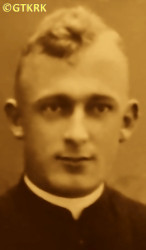
surname
ROMANOWSKI
forename(s)
Francis (pl. Franciszek)

function
diocesan priest
creed
Latin (Roman Catholic) Church RCmore on
en.wikipedia.org
[access: 2014.09.21]
diocese / province
Culm (Chełmno) diocesemore on
pl.wikipedia.org
[access: 2012.11.23]
RC Military Ordinariate of Polandmore on
en.wikipedia.org
[access: 2014.12.20]
date and place
of death
24.10.1939

Rudzki Mosttoday: district of Tuchola, Tuchola gm., Tuchola pov., Kuyavia‐Pomerania voiv., Poland
more on
en.wikipedia.org
[access: 2021.12.18]
alt. dates and places
of death
10.10.1939
VSH Resmintemporary custody
today: Radzim, Kamień Krajeński gm., Sępólno Krajeńskie pov., Kuyavia‐Pomerania voiv., Poland
more on
pl.wikipedia.org
[access: 2017.01.21]
VSH Tucheltemporary custody
today: Tuchola, Tuchola gm., Tuchola pov., Kuyavia‐Pomerania voiv., Poland
more on
en.wikipedia.org
[access: 2021.09.02]
details of death
On 28.04.1939 appointed the reserve chaplain of Polish Army, with seniority from 01.01.1939, for statutory 2 years period, in captain rank.
After German invasion of Poland on 01.09.1939 (Russians invaded Poland 17 days later) and start of the World War II arrested by the Germans prob. on 14.10.1939 together with Tuchola Polish teachers.
The arrests were carried out, as part of the Germ. «Intelligenzaktion» (Eng. „Intelligence Action”), i.e. the extermination of the Polish intelligentsia and the leadership classes of Pomerania, mainly by the genocidal unit of the Germ. Volksdeutscher Selbstschutz (Eng Ethnic German Self‐Defense), whose members were Germ. Volksdeutsche (Eng. Ethnic Germans), i.e. representatives of the German minority in Poland from Tuchola and the surrounding area, organizationally subordinated to the IV Inspectorate of the Germ. Volksdeutscher Selbstschutz with HQ in Chojnice. Supervisory functions were performed by officers of the paramilitary, genocidal Germ. Die Schutzstaffel der NSDAP (Eng. NSDAP Protection Unit), i.e. «SS», subordinate to the ruling National Socialist German Workers' Party NSDAP in Germany. Agents of several other German organizations created in the first two months of the occupation in Tuchola also participated in the repressions: Germ. Einsatzkommando 16 (Eng. 16. Task Group), i.e. EK16, which was part of the Germ. Einsatzgruppen (Eng. Operational Groups), whose task was to „clear the rear” of the German 4. Armee (Eng. 4th Army) of Germ. Wehrmacht (Eng. Armed Forces) during the conquest of Pomerania; Germ. Ordnungspolizei (Eng. Order Police), i.e. OrPo, a formation directly subordinated to the Germ. Chef der Deutschen Polizei (Eng. Chief of the German Police), Reichsführer‐SS Heinrich Himmler; and Germ. Geheime Staatspolizei (Eng. Secret State Police), i.e. Gestapo. The arrested were Poles listed in the one of the so‐called Germ. Sonderfahndungsliste (Eng. Special Wanted List), i.e. a proscription list of names of „enemies of the Reich”, prepared before the German aggression, or on some other proscription list, drawn up ad hoc on denunciations by local Germ. Volksdeutsche. They were held in the VSH Tuchel detention center in Tuchola and the VSH Resmin concentration camp in the nearby village of Radzim.
Held in VSH Tuchel custody in Tuchola.
Next interned in VSH Resmin camp.
Finally taken to the execution site.
The direct, ostentatious pretext for starting the murders was the fire of two barns and the pigsty of a German farmer, who prob. himself on 21.10.1939, while drunk, during a dance organized by his daughters, started a fire by throwing a cigar butt into the hay, and as a result, died of a heart attack. Germans organized a demonstrative funeral of the farmer, and several Poles were accused of arson. And although a summary court of the Germ. Wehrmacht acquitted the accused on 23.10.1939, the commander of the Germ. Volksdeutscher Selbstschutz in the occupied area of Gdańsk Pomerania — formally German province of Germ. Reichsgau Danzig–Westpreußen (Eng. Reich District of Gdańsk–West Prussia) was established three days later, on 26.10.1939 — the then SS‐Oberführer (later SS‐Gruppenführer) Ludolf–Hermann von Alvensleben informed of the events issued the order: „Every third day, shoot 40 Poles until the perpetrator of the fire is found. For each execution take ten more Poles, then release them for three days to search for the perpetrators of the fire. If it is not discovered, shoot them first in the next execution”.
The selection of victims was made by the Germ. Volkstribunal (Eng. People's Tribunal), a criminal kangaroo court headed by the Gestapo.
The genocidal murders — on the edge of the Tuchola Forest, between Tuchola and the Rudzki Most forest area (Germ. Rudabrücke), c. 2 km east of the center of Tuchola — were carried out by members of the Germ. Volksdeutscher Selbstschutz, led by an officer of the «SS». The victims — from VSH Tuchel and VSH Resmin — were transported in trucks. Valuables were taken from them and they were ordered to throw away any documents they possessed. They were shot in groups of six. The bodies were thrown into prepared pits (e.g. one measuring 10×1.8 m). The wounded were finished off.
Murdered in a first of a series of such mass executions. Among the victims were Fr Francis Nogalski and Fr Conrad Piątkowski, murdered with him, and Fr Peter Sosnowski, murdered 3 days later.
Altogether, between 24.10‐11.11.1939, in c. six executions, carried out c. every three days, as ordered, the Germans murdered c. 250‐560 people — including a group of Polish teachers who were invited to a „pedagogical conference” on 13‐14.10.1939 and promptly arrested. After the German defeat, during exhumation, 236/237 remains of these Germ. „fanatische Polen” (Eng. „fanatical Poles”) were recovered.
alt. details of death
According to some sources murdered in the VSH Resmin custody in Radzim.
According to still others in VSH Tuchel custody in Tuchola (or nearby forests).
cause of death
mass murder
perpetrators
Germans
sites and events
Rudzki MostClick to display the description, VSH ResminClick to display the description, VSH TuchelClick to display the description, «Intelligenzaktion»Click to display the description, Reichsgau Danzig‐WestpreußenClick to display the description, Ribbentrop‐MolotovClick to display the description, Pius XI's encyclicalsClick to display the description
date and place
of birth
14.05.1907Birth certification on:
www.genealogiawarchiwach.pl
[access: 2025.09.08]

Osietoday: Osie gm., Świecie pov., Kuyavia‐Pomerania voiv., Poland
more on
en.wikipedia.org
[access: 2021.09.02]
parents
ROMANOWSKI Thomas
🞲 ?, ? — 🕆 ?, ?

GIBAS Martha
🞲 ?, ? — 🕆 ?, ?
presbyter (holy orders)
ordination
19.12.1931

Pelplintoday: Pelplin gm., Tczew pov., Pomerania voiv., Poland
more on
en.wikipedia.org
[access: 2021.05.06]
positions held
1938 – 1939
prefect — Tucholatoday: Tuchola gm., Tuchola pov., Kuyavia‐Pomerania voiv., Poland
more on
en.wikipedia.org
[access: 2021.09.02] ⋄ State Gymnasium and High School ⋄ St Bartholomew the Apostle RC parish (main parish) ⋄ Tucholatoday: Tuchola gm., Tuchola pov., Kuyavia‐Pomerania voiv., Poland
more on
en.wikipedia.org
[access: 2021.09.02] RC deanery
1935 – 1937
prefect — Tucholatoday: Tuchola gm., Tuchola pov., Kuyavia‐Pomerania voiv., Poland
more on
en.wikipedia.org
[access: 2021.09.02] ⋄ State Teachers' Seminary for Men ⋄ St Bartholomew the Apostle RC parish (main parish) ⋄ Tucholatoday: Tuchola gm., Tuchola pov., Kuyavia‐Pomerania voiv., Poland
more on
en.wikipedia.org
[access: 2021.09.02] RC deanery
1935
vicar — Unisławtoday: Unisław gm., Chełmno pov., Kuyavia‐Pomerania voiv., Poland
more on
en.wikipedia.org
[access: 2021.09.02] ⋄ St Bartholomew the Apostle RC parish ⋄ Chełmżatoday: Chełmża urban gm., Toruń pov., Kuyavia‐Pomerania voiv., Poland
more on
en.wikipedia.org
[access: 2021.09.02] RC deanery
1934 – 1935
vicar — Pieniążkowotoday: Gniew gm., Tczew pov., Pomerania voiv., Poland
more on
en.wikipedia.org
[access: 2021.09.02] ⋄ St John the Baptist RC parish ⋄ Nowealso: Nowe nad Wisłą
today: Nowe gm., Świecie pov., Kuyavia‐Pomerania voiv., Poland
more on
en.wikipedia.org
[access: 2020.11.27] RC deanery
1934
vicar — Szembruktoday: Rogóźno gm., Grudziądz pov., Kuyavia‐Pomerania voiv., Poland
more on
en.wikipedia.org
[access: 2021.09.02] ⋄ St Bartholomew the Apostle RC parish ⋄ Grudziądz / Łasindeanery names/seats
today: Kuyavia‐Pomerania voiv., Poland RC deanery — replacement
1932 – 1934
vicar — Grudziądztoday: Grudziądz city pov., Kuyavia‐Pomerania voiv., Poland
more on
en.wikipedia.org
[access: 2021.09.02] ⋄ St Nicholas the Bishop and Confessor RC parish (main parish) ⋄ Grudziądz / Łasindeanery names/seats
today: Kuyavia‐Pomerania voiv., Poland RC deanery
1927 – 1931
student — Pelplintoday: Pelplin gm., Tczew pov., Pomerania voiv., Poland
more on
en.wikipedia.org
[access: 2021.05.06] ⋄ philosophy and theology, Theological Seminary
1923 – 1926
pupil — Chełmnotoday: Chełmno urban gm., Chełmno pov., Kuyavia‐Pomerania voiv., Poland
more on
en.wikipedia.org
[access: 2021.07.25] ⋄ State Old Classical Gymnasium for Boys — studies crowned with the maturity diploma (i.e. matura)
1918 – 1923
pupil — Pelplintoday: Pelplin gm., Tczew pov., Pomerania voiv., Poland
more on
en.wikipedia.org
[access: 2021.05.06] ⋄ „Collegium Marianum” progymnasium
pupil — Osietoday: Osie gm., Świecie pov., Kuyavia‐Pomerania voiv., Poland
more on
en.wikipedia.org
[access: 2021.09.02] ⋄ elementary school
others related
in death
KREFFTClick to display biography Constantine Francis, NOGALSKIClick to display biography Francis, PIĄTKOWSKIClick to display biography Conrad, SOSNOWSKIClick to display biography Peter
sites and events
descriptions
Rudzki Most: In Rudzki Most Germans, as part of their «Intelligenzaktion» — extermination of Polish intelligentsia in Pomerania — in six mass executions between 24.10‐10.11.1939 murdered approx. 560 Poles from Tuchola and Sępólno Krajeńskie counties. The executions were ostensibly carried out in retaliation for the burning of two barns and pigsty belonging to a German farmer, which prob. himself started the fire himself while intoxicated by throwing a cigar butt into the hay, who as a result died of a heart attack. The executions were to last, according to the Germans, „until the arsonist was caught”. 11.1946, during the exhumation, 6 mass graves were discovered, in which 236/237 human corpses were recovered. (more on: pl.wikipedia.orgClick to attempt to display webpage
[access: 2021.12.19], en.wikipedia.orgClick to attempt to display webpage
[access: 2013.07.06])
VSH Resmin: German Germ. Volksdeutscher Selbstschutzhaft (Eng. Volksdeutscher Selbstschutz custody) VSH — established for the inhabitants of Krajna land by the genocidal German paramilitary organization Volksdeutscher Selbstschutz — the decision to create Selbstschutz in the Polish lands occupied by German troops was made in Berlin on 08‐10.09.1939 at a conference headed by Reichsführer‐SS Heinrich Himmler (the formal order bears the date 20.09.1939), and the chaotically formed units were directly subordinated to the officers of the genocidal SS organization — on an estate in the village of Radzim, operating from 10.1939 till 12.1939. Germans held exclusively men in the camp; (some women and children who were accidently brought to the camp were murdered on the spot). Among others on c. 15.01.1939 Germans brought to it — and to a small Komierowo sub‐camp, c. 10 km away — all prisoners of a nearby — c. 10 km — VSH Drausnitz custody in Drożdzienica. As a part of «Intelligenzaktion» — aimed at extermination of Polish intelligentsia and ruling classes in Pomerania — Germans murdered in Radzim approx. 5,000 victims. They were murdered at the camp itself (mainly in the manor’s park) or executed outside, in a site of mass executions in Rudzki Most n. Tuchola among others. (more on: pl.wikipedia.orgClick to attempt to display webpage
[access: 2013.05.19])
VSH Tuchel: Germ. Volksdeutscher Selbstschutzhaft (Eng. Volksdeutscher Selbstschutz detention center) VSH for the inhabitants of the Tuchola region, founded in 09/10 1939 by Germ. Volksdeutsche (Eng. Ethnic Germans), members of the genocidal paramilitary formation Germ. Volksdeutscher Selbstschutz (Eng. Ethnic Germans Self‐Defense) — the decision to create Selbstschutz on Polish territories occupied by German troops was made in Berlin on 08‐10.09.1939 at a conference headed by Reichsführer‐SS Heinrich Himmler (the formal order bears the date 20.09.1939), and the chaotically formed units were directly subordinated to the officers of the genocidal Germ. Die Schutzstaffel der NSDAP (Eng. NSDAP Protection Units), i.e. «SS», a paramilitary formation subordinate to the ruling National Socialist German Workers' Party NSDAP. Polish prisoners were held in a local detention center (since 02.09.1939 when the Germans entered Tuchola), in the gymnasium of a Polish social organization, and in the building of the Teachers' Seminary. Initially, these were individuals whose names appeared the one of the so‐called Germ. Sonderfahndungsliste (Eng. Special Wanted List), i.e. a proscription list of names of „enemies of the Reich”, prepared prior to the German aggression. Later, all those deemed by the Germans to pose a threat to their state were detained, as well as those with whom the Germans were „settling personal scores”‐i.e. which found themselves on the proscription lists drawn up ad hoc on the denounciations by the local Volksdeutsche. Among them were teachers, school principals, merchants, craftsmen, farmers, priests, foresters, postmen, railway workers, policemen, and local officials. The Germans deported some of the detainees to Germany, but murdered most in nearby forests, including Rudzki Most. (more on: pl.wikipedia.orgClick to attempt to display webpage
[access: 2021.12.19])
«Intelligenzaktion»: German: «Intelligenzaktion» (English: „Intelligence Action”) — a German program of extermination of the Polish elite, mainly the intelligentsia and leadership layers, carried out from the beginning of the occupation in w 09.1939 to 04.1940, mainly in territories directly annexed to Germany, but also in the so‐called Germ. Generalgouvernement (Eng. General Governorate), where it was called «AB‐aktion». In the first phase, immediately after the beginning of the German occupation, during military operations carried out by the Germ. Wehrmacht (Eng. Armed Forces) and the genocidal units of the Germ. Einsatzgruppen (Eng. Operational Groups) of the Germ. Sicherheitspolizei (Eng. Security Police), i.e. SiPo, and Germ. Sicherheitsdienst des Reichsführers SS (Eng. Security Service of the Reichsführer SS), i.e. SD, organized by the Germ. Reichssicherheitshauptamt (Eng. Reich Main Security Office), i.e. RSHA, which followed the troops, carried out under the Germ. Unternehmen „Tannenberg” (Eng. Operation „Tannenberg”) — based on the so‐called Germ. Sonderfahndungsliste (Eng. Special Wanted Lists), i.e. proscription lists of Poles considered particularly dangerous to the Third Reich, prepared by the Zentralstelle II/P (Polen) unit of the German RSHA. Later, implemented by the German civilian occupation authorities and the genocidal unit of the Germ. Volksdeutscher Selbstschutz (Eng. Ethnic Germans Self‐Defense), whose members were Germ. Volksdeutsche (Eng. Ethnic Germans), i.e. representatives of the German minority in Poland. According to various sources, these lists, at the beginning of 09.1939, could have contained the details of 61,000—88,000 „dangerous” Poles — although these figures cannot be confirmed. In total, during this genocide, c. 50,000 teachers, Catholic priests, representatives of the landed gentry, freelancers, social and political activists, and retired military personnel were systematically and methodically murdered. Another 50,000 were sent to concentration camps, where only a negligible percentage survived. (more on: en.wikipedia.orgClick to attempt to display webpage
[access: 2014.10.04])
Reichsgau Danzig‐Westpreußen: After the Polish defeat in the 09.1939 campaign, which was the result of the Ribbentrop‐Molotov Pact and constituted the first stage of World War II, and the beginning of German occupation in part of Poland (in the other, eastern part of Poland, the Russian occupation began), the Germans divided the occupied Polish territory into five main regions (and a few smaller). The largest one was transformed into Germ. Generalgouvernement (Eng. General Governorate), intended exclusively for Poles and Jews and constituting part of the so‐called Germ. Großdeutschland (Eng. Greater Germany). Two were added to existing German provinces. From two other separate new provinces were created. Vistula Pomerania region was one of them, incorporated into Germany on 08.10.1939, by decree of the German leader Adolf Hitler (formally came into force on 26.10.1939), and on 02.11.1939 transformed into the Germ. Reichsgau Danzig‐Westpreußen (Eng. Reich District of Gdańsk‐West Prussia) province, in which the law of the German state was to apply. The main axis of the policy of the new province, the territory of which the Germans recognized as the Germ. „Ursprünglich Deutsche” (Eng. „natively German”), despite the fact that 85% of its inhabitants were Poles, was Germ. „Entpolonisierung” (Eng. „Depolonisation”), i.e. forced Germanization. C. 60,000 Poles were murdered in 1939‐1940, as part of the Germ. „Intelligenzaktion”, i.e. extermination of Polish intelligentsia and ruling classes, in c. 432 places of mass executions — including c. 220 Polish Catholic priests. The same number were sent to German concentration camps, from where few returned (over 300 priests were arrested, of whom c. 130 died in concentration camps). C. 124,000‐170,000 were displaced, including c. 90,000 to the Germ. Generalgouvernement. Poles were forced en masse to sign the German nationality list, the Germ. Deutsche Volksliste DVL. Polish children could only learn in German. It was forbidden to use the Polish language during Catholic Holy Masses and during confession. Polish landed estates were confiscated..To further reduce the number of the Polish population, Poles were sent to forced labor deep inside Germany. The remaining Poles were treated as low‐skilled labor, isolated from the Germans and strictly controlled — legally, three or three of them could only meet together, even in their own apartments. Many were conscripted into the German Wehrmacht army. After the end of hostilities of World War II, the overseer of this province, the Germ. Reichsstatthalter (Eng. Reich Governor) and the Germ. Gauleiter (Eng. district head) of the German National Socialist Party, Albert Maria Forster, was executed. (more on: en.wikipedia.orgClick to attempt to display webpage
[access: 2024.06.24])
Ribbentrop‐Molotov: Genocidal Russian‐German alliance pact between Russian leader Joseph Stalin and German leader Adolf Hitler signed on 23.08.1939 in Moscow by respective foreign ministers, Mr. Vyacheslav Molotov for Russia and Joachim von Ribbentrop for Germany. The pact sanctioned and was the direct cause of joint Russian and German invasion of Poland and the outbreak of the World War II in 09.1939. In a political sense, the pact was an attempt to restore the status quo ante before 1914, with one exception, namely the „commercial” exchange of the so‐called „Kingdom of Poland”, which in 1914 was part of the Russian Empire, fore Eastern Galicia (today's western Ukraine), in 1914 belonging to the Austro‐Hungarian Empire. Galicia, including Lviv, was to be taken over by the Russians, the „Kingdom of Poland” — under the name of the General Governorate — Germany. The resultant „war was one of the greatest calamities and dramas of humanity in history, for two atheistic and anti‐Christian ideologies — national and international socialism — rejected God and His fifth Decalogue commandment: Thou shall not kill!” (Abp Stanislav Gądecki, 01.09.2019). The decisions taken — backed up by the betrayal of the formal allies of Poland, France and Germany, which on 12.09.1939, at a joint conference in Abbeville, decided not to provide aid to attacked Poland and not to take military action against Germany (a clear breach of treaty obligations with Poland) — were on 28.09.1939 slightly altered and made more precise when a treaty on „German‐Russian boundaries and friendship” was agreed by the same murderous signatories. One of its findings was establishment of spheres of influence in Central and Eastern Europe and in consequence IV partition of Poland. In one of its secret annexes agreed, that: „the Signatories will not tolerate on its respective territories any Polish propaganda that affects the territory of the other Side. On their respective territories they will suppress all such propaganda and inform each other of the measures taken to accomplish it”. The agreements resulted in a series of meeting between two genocidal organization representing both sides — German Gestapo and Russian NKVD when coordination of efforts to exterminate Polish intelligentsia and Polish leading classes (in Germany called «Intelligenzaktion», in Russia took the form of Katyń massacres) where discussed. Resulted in deaths of hundreds of thousands of Polish intelligentsia, including thousands of priests presented here, and tens of millions of ordinary people,. The results of this Russian‐German pact lasted till 1989 and are still in evidence even today. (more on: en.wikipedia.orgClick to attempt to display webpage
[access: 2015.09.30])
Pius XI's encyclicals: Facing the creation of two totalitarian systems in Europe, which seemed to compete with each other, though there were more similarities than contradictions between them, Pope Pius XI issued in 03.1937 (within 5 days) two encyclicals. In the „Mit brennender Sorge” (Eng. „With Burning Concern”) published on 14.03.1938, condemned the national socialism prevailing in Germany. The Pope wrote: „Whoever, following the old Germanic‐pre‐Christian beliefs, puts various impersonal fate in the place of a personal God, denies the wisdom of God and Providence […], whoever exalts earthly values: race or nation, or state, or state system, representatives of state power or other fundamental values of human society, […] and makes them the highest standard of all values, including religious ones, and idolizes them, this one […] is far from true faith in God and from a worldview corresponding to such faith”. On 19.03.1937, published „Divini Redemptoris” (Eng. „Divine Redeemer”), in which criticized Russian communism, dialectical materialism and the class struggle theory. The Pope wrote: „Communism deprives man of freedom, and therefore the spiritual basis of all life norms. It deprives the human person of all his dignity and any moral support with which he could resist the onslaught of blind passions […] This is the new gospel that Bolshevik and godless communism preaches as a message of salvation and redemption of humanity”… Pius XI demanded that the established human law be subjected to the natural law of God , recommended the implementation of the ideal of a Christian state and society, and called on Catholics to resist. Two years later, National Socialist Germany and Communist Russia came together and started World War II. (more on: www.vatican.vaClick to attempt to display webpage
[access: 2023.05.28], www.vatican.vaClick to attempt to display webpage
[access: 2023.05.28])
sources
personal:
www.niedziela.plClick to attempt to display webpage
[access: 2013.01.18], www.genealogiawarchiwach.plClick to attempt to display webpage
[access: 2025.09.08], www.kpbc.ukw.edu.plClick to attempt to display webpage
[access: 2014.10.04], www.straty.plClick to attempt to display webpage
[access: 2015.04.18]
bibliographical:
„Biographical dictionary of priests ordained in the years 1921‐1945 working in the Chełmno diocese”, Fr Anastasius Nadolny, prof., Bernardinum publishing house 2021
original images:
www.ztn.com.plClick to attempt to display webpage
[access: 2018.11.18], www.katedrapolowa.plClick to attempt to display webpage
[access: 2014.01.16]
LETTER to CUSTODIAN/ADMINISTRATOR
If you have an Email client on your communicator/computer — such as Mozilla Thunderbird, Windows Mail or Microsoft Outlook, described at WikipediaPatrz:
en.wikipedia.org, among others — try the link below, please:
LETTER to CUSTODIAN/ADMINISTRATORClick and try to call your own Email client
If however you do not run such a client or the above link is not active please send an email to the Custodian/Administrator using your account — in your customary email/correspondence engine — at the following address:

giving the following as the subject:
MARTYROLOGY: ROMANOWSKI Francis
To return to the biography press below:
 Click to return to biography